What Is Outdoor Advertising? Outdoor Media And OOH Explained

If you have ever looked up and noticed a billboard, an ad at a bus stop, or a message on a screen in a busy plaza, you have seen outdoor advertising in action. What is outdoor advertising in plain terms? It is advertising designed to reach people when they are out in the world, not sitting at home.

You will also hear it called outdoor media or OOH, which stands for out of home. These terms are often used interchangeably. In this guide, you will learn what is outdoor advertising, what formats matter most, how to pick the right placements, and how to think about measurement so you can plan with confidence.

bMedia Group helps brands plan and run outdoor campaigns across Puerto Rico with a technology-forward approach, 500+ locations, and the ability to reach 90% of the population in minutes.

What Is Outdoor Advertising And Why It Works

What is outdoor advertising really doing for your business? It puts your message in front of people during real life moments: commuting, shopping, meeting friends, traveling, and running errands.

Outdoor works best when you need:

  • Broad awareness fast
  • Repetition that builds familiarity
  • Strong local presence by region
  • A message that is easy to understand in a few seconds

Outdoor media is not about cramming information. It is about being clear, visible, and present where your customers already are.

outdoor media

Outdoor Advertising Formats You See Every Day

Outdoor media is a big category. Here are common formats, plus how they typically fit into a plan.

Billboards

Billboards are large placements along highways and major roads. They are ideal when you want high reach and steady visibility.

Digital Billboards (DOOH)

DOOH means digital out of home. These are screens that can rotate multiple ads. They are useful when you want flexibility, quicker creative swaps, or day-part messaging.

Posters And Street-Level Placements

Posters and street furniture (bus shelters, benches, kiosks) sit closer to eye level. They can be excellent for neighborhood targeting and pedestrian-heavy areas.

Transit Advertising

Transit placements include buses and areas around transit hubs. They work well when your audience moves through the same routes every week.

Place-Based Media

This includes formats like:

  • Restroom ads
  • Gas station ads
  • Medical office ads
    These can be effective when you want to reach people in specific settings where they have more time to read.

Outdoor Advertising In Puerto Rico

Outdoor planning improves a lot when you stop thinking “island wide” as one big idea and start thinking in zones.

A practical way to approach it is:

  • Metro reach: San Juan, Bayamón, Carolina, Caguas
  • South and west coverage: Ponce, Mayagüez
  • North corridor: Arecibo and surrounding routes

With bMedia Group’s scale across 500+ locations and a planning approach built around reach and performance, you can match placements to real movement patterns, not guesses.

Quick Decision Guide: Pick Your Format By Goal

If your goal is speed and flexibility

  • Choose DOOH
    Best for promotions, multiple messages, seasonal swaps, and fast creative updates.

If your goal is always-on presence

  • Choose static billboards
    Best for brand recognition, consistent visibility, and simple, memorable messaging.

If your goal is impact

  • Choose spectacular placements
    Best for major brand moments, launches, and high-attention environments where size and placement do the heavy lifting.

Simple Comparison: Digital vs Static vs Spectacular

  • Digital (DOOH): flexible, can rotate messages, great for timing and testing
  • Static: steady, simple, consistent, ideal for long runs
  • Spectacular: premium visibility, high impact, best for big statements

What Drives Cost In Outdoor Advertising

Outdoor pricing is not one flat number. It usually depends on:

  • Location: traffic volume and visibility
  • Format: digital vs static vs premium placements
  • Duration: how long your campaign runs
  • Share of time (digital): how often your ad appears on a loop
  • Production needs: printing, file specs, creative revisions

Quick Details Block: Budget Inputs You Should Know

  • Regions you want to cover
  • Formats you want to use
  • Timeline and start date window
  • Whether you need one message or multiple versions
  • Your primary outcome: reach, traffic, brand lift, or launches

If you bring those inputs to the table, planning becomes faster and more accurate.

How Outdoor Advertising Is Measured

You do not need to be a media buyer to understand measurement. Here are the key terms, in plain language:

  • Impressions: estimated views of your ad
  • Reach: how many different people you may reach
  • Frequency: how often those people may see the ad
  • CPM: cost per thousand impressions, a common way to compare efficiency across channels

Outdoor planning works best when you set expectations clearly:

  • Outdoor is strong at awareness and recall
  • It supports other channels by keeping your brand top of mind
  • It performs better when the message is simple and the placement matches your audience

bMedia Group’s approach stays focused on measurable outcomes, CPM efficiency, targeting by region, and realistic performance reporting without promising exact results.
outdoor advertising

Creative Rules That Make Outdoor Work

Outdoor ads are seen quickly. Your design has to do its job fast.

bMedia Creative Checklist

  • Keep it to one clear message
  • Use large fonts that can be read at distance
  • Strong contrast between text and background
  • One main visual, not a collage
  • Brand name or logo visible, but not cramped
  • If you include a call to action, keep it short
    Think “Visit,” “Call,” or a simple URL. Avoid long sentences.

Quick Details Block: What You Need To Provide

  • Your logo and brand colors
  • One headline or offer
  • One main image (high quality)
  • Any required disclaimer text, if applicable
  • Preferred landing page or phone number

If your ad needs people to remember a phone number, consider pairing it with formats where people have more time, like place-based media. For highway billboards, keep actions simple.

Timeline: How To Plan Without Stress

Outdoor campaigns go smoothly when you give yourself enough time for creativity and approvals.

Planning Timeline (Typical)

  • Week 1: choose region, format, and schedule
  • Week 2: finalize creative and specs
  • Week 3: production and confirmations
  • Launch: monitor, report, and adjust if using DOOH rotations

If you are planning around seasonal demand, aim to start earlier for high-competition periods like holidays, major travel windows, or back-to-school. You do not need exact dates to plan well. You just need a clear window and a clear message.

Common Mistakes To Avoid

These are the issues that most often reduce results:

  • Trying to say too much in one ad
  • Picking locations without matching the audience
  • Running too short to build frequency
  • Using designs that look good on a laptop but fail at distance
  • Skipping measurement expectations until after launch

Outdoor advertising is simple when you treat it like a planning problem, not a guessing game.

Bringing It All Together With bMedia Group

Now you can answer the core question, what is outdoor advertising and how it fits into real business goals. Outdoor media works when your plan is clear: audience, region, format, timeline, creative constraints, and measurement.

bMedia Group brings island-wide scale, 500+ locations, and technology-driven planning to help you run campaigns that are practical, trackable, and built for real visibility across Puerto Rico. If you want to turn outdoor advertising into a repeatable growth channel, start with a format mix that matches your goal, then build creative that can be understood in seconds.

Out-of-the-Box Marketing Ideas

When it comes to marketing, most people think that you need an army of promoters, designers, and developers to launch a successful marketing campaign. But that’s not true.

All marketing is, is about creating a strategy, identifying your target audience and then executing it in a way that resonates with them, and that is no different than with out-of-home advertising such as billboards.

It can be a difficult process to get right but one of the best things about it is the opportunity for creativity and innovation along the way.

So, if you’re looking for some inspiration on how to do just that, we can help! We have put together this list of our favorite out-of-the-box marketing ideas that will help you stand out from the crowd and win customers over before they even know what hit them.

marketing ideas

What is An Out-of-Box Marketing Strategy?

Out of the box marketing comes down to one thing – data-driven marketing with emerging strategies.

For instance, if you choose to buy a placement on a billboard, using data technologies that measure traffic and the prospective reach is one thing, but merging that with custom URLs, hashtags, or QR codes creates an ecosystem that propels brand awareness and experience.

Below are ten out of the box marketing ideas that can help benefit you and your business.

Offer a Trade

If you have a product that has value and your customers don’t want it, they’ll probably be willing to trade something else instead. This is a great way to get rid of products that are too expensive to distribute or not selling well.

There are many ways you can offer trades:

  • Trade-in credit: Offer customers the option of trading in their old product for store credit toward future purchases. This can be especially useful when selling electronics or other expensive items that require replacement parts or repairs regularly.
  • Gift card swap: You could give out gift cards at the checkout counter when someone makes a purchase, but then offer them the option of also receiving an extra gift card for every item they trade in as well! This could double or triple your return on investment (ROI) from these discounted sales because people will actually buy another item with their first credit rather than just leaving empty handed—which happens more often than not when companies only offer one type of payment option during checkout processes like this one does.

digital marketing ideas

Use Digital Signage

Digital signage is the use of digital technology to promote products, services, events and brand messages on large displays in public locations – such as stadiums, shopping malls and terminals.

Digital signage serves a number of purposes including:

  • Promoting your business
  • Providing information to customers on where they can find what they’re looking for or what is happening in the area

Create a Scavenger Hunt

This is a great way to get your team or clients involved and increase brand awareness/loyalty.

Create a list of items, then take pictures or video of them in your office and store it online or across social media so your participants can see them.

On the day that you launch your scavenger hunt, send out an email with instructions for how to participate (you can also post on social media if you have room for more exposure). The instructions should include what image(s) are needed from each location, how participants will know when they’ve found the item(s) needed and other details like this one: “The first person who finds [an item] at [location] wins!”.

Make sure the prizes are worth winning! It’s always good to give away something that has value because it shows appreciation towards those who took time out of their busy days in order to participate. The prize doesn’t have to be big though; it just needs something special about it so people feel good about themselves after receiving one as opposed to feeling like they’re just some dumb loser who couldn’t find anything cool enough.

Use the Mail

  • Use the mail to send coupons, information about your business or products, and thank you cards.
  • Send holiday cards to customers, friends, and family that have expressed interest in your business.
  • Send birthday cards for every employee, including yourself! It’s important for employees to feel connected to the company beyond just working together on projects.

Go Mobile With Mobile Coupons or QR Codes

Using billboards or fuel pump advertising allows the use of QR codes.

QR codes saw a resurgence during the 2020 COVID lockdowns, and the momentum has not stopped.

QR codes can offer mobile coupons that are a great way to reach your audience and get them into your store. They can also be used in many ways. For example, you could offer free shipping on a certain day or time period, or coupons for discounts on items in your store. Mobile coupons are also helpful for getting people to try new things, like offering free samples at checkout counters.

Create a Viral Marketing Campaign

When you think of your content, don’t limit yourself to what’s on the paper in front of you.

Think about how you can add value to that content. For example, in a recent film “Smile”, the marketing team sent paid actors to baseball games to ‘Smile’ for the duration. The goal was to raise awareness but also to creatively expand the audience in a viral marketing effort.

Viral marketing combines out of home marketing with digital marketing and PR to produce word of mouth awareness.

Host an Event at Your Place of Business

Hosting an event at your business is a great way to get your brand in front of your customers. For example, if you’re a barber shop or salon, you can host an event where people come in for discounted haircuts. This is also a great way to build brand loyalty and engage with customers on a deeper level.

You don’t have to hold the event at your place of business either! You could host it off site and encourage people from all over town or even around the world to attend. This gives them something fun and entertaining while also bringing more traffic into your store or office space.

Give Away Swag

Gifting swag is a great way to get your name out there. The trick is to give away something that’s relevant to your business, useful for the customer, and not too expensive. A good example of this is offering an in-store coupon when people bring their pets in for grooming.

You should also try gifting things that will get people talking about your brand and put you at the forefront of their minds — like branded water bottles or reusable totes!

Go ‘Live’ on Social Media Platforms

Live video is a great way to connect with your audience. It’s a great way to show off your products, new or old. You can use live video to promote a new product or service, share information about your company, and even answer questions from people who are interested in what you have to offer.

Get Local Businesses Involved in a Larger Campaign

  • Think about how you can work with other businesses in your area.
  • Get them involved in a larger campaign, and ask them to promote your business for free.
  • Offer them a free service in return for their support.
  • Offer them a discount on one of your services or products if they agree to help promote it through their own channels (e.g., website, social media).
  • Give away free gifts to people who attend events at another business’s location (e.g., restaurant) as part of an event of yours that’s happening nearby—this could be tickets or gift certificates that they can use on their next visit!

marketing strategy session

Think Outside the Box for Creative Marketing Ideas

The best way to get creative marketing ideas is to think outside the box. If you are getting stuck on a project and need some inspiration, here are some ways to help you come up with unique ideas for your business:

  • Get on the internet! There are so many websites out there that provide excellent resources when it comes to searching for creative marketing ideas. There are also plenty of blogs and articles written by successful entrepreneurs who have used these techniques before.
  • Use what works! If an idea worked well in the past, there’s no reason why it won’t work again! Don’t be afraid of trying something again if enough time has passed since its initial success; after all, nothing beats experience when it comes down to figuring out how effective certain techniques can be at generating interest among potential customers.
  • Survey your audience! Go right to the source and ask what they want to see more of from your business or brand.

bMedia and Out-of-the-Box Marketing Ideas

Out of the box marketing ideas come in many shapes and sizes. While viral marketing worked for the team promoting a film, it’s best to consider your options, keep an open mind, and find a partner that can help you achieve your KPIs.

As a local leading media promotion company, our goal is to provide advertising avenues that make your message get through to your target market in order to solidify your brand image and / or increase your sales through impact, quality, innovation, and distinct services. We’re

Contact bMedia and learn more about our services and how we can help promote your business.

Brand Amplification

The post-COVID landscape is fraught with competition between brands. Businesses with compelling messaging and impactful marketing can identify with their audience and stand head and shoulders above their competition – so long as they know which strengths and goals to amplify, of course. Brand amplification lets you attract more customers and bring together your existing ones, and it’s the key to building long-lasting brand loyalty and customer relationships.

Brand amplification done right makes lasting first impressions on your customers and keeps people thinking about your brand long after you make that great first impression.

Sounds great, right? We think so, too.

To that end, let’s cover what brand amplification is, why it’s so important, how to amplify your brand with billboards, and how to measure your brand amplification.

amplification

Brand Amplification: What It Means and Why You Need It

Let’s face it: these days, people who engage with a brand are looking for more than just industry-leading services and products. They’re looking for brands that share similar values and promote those values genuinely.

Why? Because it’s easier for a prospective customer to connect with (and trust) an organization that lives out its values authentically. Brand amplification communicates the heart of your brand by highlighting its values, stories, and core message.

Think about what makes your brand stand out from its competitors, what makes it unique, and why what it does is meaningful. These insights are the stepping stones to successfully amplifying your brand. The more insights you have into the core of your brand, the easier you can convey authentic, compelling stories to your audience.

By now you may be wondering, “Do I really need brand amplification to be competitive?” If you want to build an experience that’s consistent across your customer touch-points, then the answer is a resounding “Yes!”

A well-thought-out, articulated strategy for your brand benefits more than just your audience. The most effective brand strategies give your staff members and third-party agencies a brand hierarchy that lets them establish consistency across customer touch-points. From the typeface on your website’s landing page to the logo you use on all your products, articulated brand strategies impact all your key assets.

Above all, though, brand amplification defines the type of business you want to build. It identifies the type of people you want to employ, the values you stand behind, and, of course, the values you adamantly oppose.

Now that you know a little bit more about brand amplification and why it’s so important to have, it’s time to dig into the nitty-gritty of actually amplifying your brand: let’s dive into some ways you can amplify your brand using billboards.

brand amplification billboard

How to Amplify Your Brand with Billboards

In today’s hyperconnected world, it’s true that ads on social media tend to dominate the marketing landscape. The popularity that social media ads enjoy may lead some to believe that billboards are no longer a viable form of marketing – this couldn’t be farther from the truth!

Whereas social media ads are often complex and sometimes vague and ambiguous, billboards are reliably straightforward and simple. There are plenty of ways to build a billboard campaign that’s effective and impactful, but we’ve picked a few tips that you simply can’t go without when using billboards for brand amplification.

1. Keep things simple

When designing a billboard, it can be tempting to cram as much info as possible onto your billboard. After all, you’ve got a lot to say about your brand, right? As great as it is to be passionate about your messages and values, though, too much content on one billboard can make it tough to distill your brand down into a single image.

Rather than include as much content as possible, it’s best for your billboard to concisely convey what your brand can do for its customers. What do you have that your target audience may be searching for? Is there info you think may intrigue someone to find out more about what you offer? These are the questions to keep in mind when building out your first billboards – just remember to keep everything as simple as possible.

2. Use geography to your advantage

When it comes to getting your billboards in front of more interested eyes, geography is your best friend. You’ll want to determine your target audience’s most common locations and habits so that you can get more eyes on it quickly.

If your target audience is mostly in a smaller geographical area, you may also want to consider using locally relevant billboards to get impactful results. Thinking of running a billboard campaign to target an audience in San Juan, for example? Try weaving in something unique to the city that may not resonate as well with the rest of Puerto Rico.

3. Use digital billboards for more dynamic marketing

As much as we love the simplicity and reliability that traditional billboards offer, there’s something to be said about the flexibility that digital billboards provide. Digital billboards let your marketers make things more dynamic since they can run different designs during different times of the day. Want to display one design during the early morning and another after the sun sets? Digital billboards have you covered.

Digital boards are particularly handy if you’re still tinkering with brand logos and product images. You can take a couple of risks using different designs without having to double down on a single board design that’s tied to your marketing budget.

billboard brand amplification

Measuring Your Brand Amplification

Don’t forget that once you’ve taken the above tips to heart, you’ll want to start measuring how successful your brand amplification is. We recommend that you keep an eye on spikes and dips in your website traffic, the number of shares and comments you get on your social channels, and increases in customer phone calls. You can use tools like Google Analytics to monitor the bounce rates on your website’s pages and Facebook to monitor your audience engagement and tie that engagement to recent posts you’ve shared.

Successful brand amplification doesn’t happen overnight; realistically, you can expect to spend at least a couple of months settling into a rhythm and locking down a brand voice you like. Once you find your groove, however, we guarantee that you’ll begin building trust and recognition among your target audience!

Go To Market Strategy for Startups

We don’t mean to intimidate you (and maybe you were already aware), but there’s something you need to know: Studies show that 90% of all startups fail within five years of formation — not a very reassuring statistic, right? But what’s the story behind this damning figure?

It all comes down to obscurity. Simply put, nobody knows about your business or what products/services you offer. In an ideal world, you could pour endless amounts of cash into a marketing push that announces your presence to the world with gusto, but, as we’re sure we’re both painfully aware, this is no ideal world.

Not only are advertising budgets rather meager for startups, you’re up against other businesses with established product-market-fit, which is daunting, to say the least… but there is a way to cut through the competition and get your voice heard – an effective go-to-market strategy for startups.

marketing strategy for startups

What Exactly Is A Go-To-Market Strategy, And Why Is It Important For Startups?

A go-to-market strategy for startups is precisely what it sounds like – an advertising game-plan that breaks an unknown product or service into a target market; it’s your key to the locked door of commerce!

Your go-to-market strategy is a blueprint that illustrates how you will reach the people you want to reach with the message you want them to hear. It’s considered a separate entity to standard marketing stratagems, as they imply an established market position, whereas GTM is a way of reaching an initial audience from nothing.

It’s the foundation on which all your future marketing campaigns will be based, and a strong foundation inspires confidence, not just within your target audience, but among your investors, too. Creating a GTM strategy is the ultimate way to position your business for success moving forward. Other GTM benefits include…

  • Weeding out potential risks
  • Generating profit quickly
  • Developing your business and product/service
  • Attaining you a competitive edge over other startups

Creating a Go-To-Market Strategy For Your Startup

The three pillars you’ll need to know for a go-to-market strategy for startups are the What, Who, and How

  • What are you trying to sell?
  • Who needs what you’re trying to sell?
  • How are you going to introduce your offering to those who need it?

If you can answer these questions, you’ll have laid the foundation for a successful entrance into your particular niche of the market, so let’s consider how this can be done.

Step 1. Know Your Audience

You may well have come up with the concept of your product or service through finding gaps or weaknesses in the market yourself, and that’s great; it means whatever you come up with has some form of real-world appeal, but now you have to find others like yourself and figure out what makes them tick.

Hone in on your target audience, and try to map out their behaviors and general way of thinking. Forget about trying to sell something to the world; focus on this very finite group of people and figure out exactly what they’re looking for.

Modern consumers expect businesses to know all about their wants and needs, but we’re not mind readers, so instead, we can build up a customer persona by… This applies to all types of businesses. It doesn’t matter if you are a digital service providing with a nationwide audience, like providing legal wills online, or a brick and mortar business creating tangible products to specific locations, like a vodka distillery, knowing your audience is crucial.

Scheduling Interviews with Potential Users

Interviewing people takes time, but you won’t find more rich, accurate, and enlightening results via any other means, so it pays to talk to prospective customers face-to-face.

Far more fluid and personal than standardized surveys, interviews give you a real insight into the lives of people who your product/service could help, which is a great way to gather data you can use at a later date to refine your offering.

Be wary of time constraints and ask effective questions, such as…

  1. What are their preferred channels of communication (e.g. email, Facebook, Instagram, TikTok, billboards, etc)?
  2. What are they disappointed by or lacking?
  3. In their eyes, what makes a product or business effective and valuable?

survey your audience

Questionnaires

Interviews are fantastic sources of information, but they’re almost too focused. Although you’re narrowing your research to drum up a customer persona, you still need to venture further afield to ascertain splits in that persona in terms of age, profession, location, etc, and questionnaires are a great way to do so.

The wider net you cast will give you more of an insight into what pain points are simply individual woes and which are felt universally, ripe for capitalization.

However, do bear in mind that you’ll need to provide some form of incentive to encourage people to complete your questionnaire, and try to keep it short and sweet, too — we’re all busy people.

Purchase Pre-Existing Data

There are countless other companies that have had to study their target audience before you founded your startup, and you can use this to your advantage.

Paying for research carried out by similar companies gives you effort-free results. Now, they’re not going to be quite as accurate as the results you’ll get from your own studies, but they can certainly help to create a more substantive customer persona in a short amount of time.

Due to its immediacy, this method is often employed first as a sort of scattershot data drive. It gives you a rough estimate of things like target consumer age, location, profession, income, pain points, and purchase triggers.

Step 2. Know Your Competitor

If you’re going to offer something new, you need to know what your competitor is already bringing to the table. If an established entity has beaten you to the punch, your chances of gaining traction with a GTM strategy are slim-to-none. Find ways around it.

Step 3. Coming Up With a Value Proposition

In a nutshell, a value proposition is a snappy headline followed by 2–3 sentences that divulge why your product/service:

  • Is relevant to the user
  • Solves the user’s problem
  • Is unique and cannot be found elsewhere

For example, let’s say you’ve invented an automatic garlic clove peeler. Your value proposition should establish that garlic is one of the most common ingredients in cuisine around the globe (relevance), it makes the tough job of peeling cloves effortless (problem solved), and it’s a patented design (unique).

It’s important not to get caught up in mentioning features alone. To entice customers, you need to tell them in no uncertain words how it will make their life easier or more enjoyable.

Step 4. Establish The Best Lines Of Communication For Reaching Your Target Audience

With your target audience in sight, it’s time to find out how to reach them. People of different age groups and professions communicate and are exposed to things in unique ways.

For example, younger people will consume a lot of adverts on social media platforms like TikTok and Instagram, while older generations may only use Facebook or perhaps even just email.

Another example is that people working from home will engage with mostly digital adverts, but for those who commute to an office, billboard advertising will be highly effective.

Don’t feel you have to settle for just one mode of communication per faction of your target audience. Research has shown that omnichannel approaches to customer communication have a much higher retention rate than single-channel approaches.

go to market strategy

Step 5. Zeroing In On Marketing Tactics

People don’t just use different channels of communication, they also have preferences in regard to how they’re engaged with.

For instance, certain demographics may respond well to the personal/celebrity touch of paid partnerships, while others will be distrustful of this tactic as the pecuniary aspect of the agreement makes the brand representative seem disingenuous and the product seem weak.

Step 6. Don’t Stop Testing

Even if you think you’ve got everything figured out, you need to keep on testing your theories by measuring advertising effectiveness. Test different styles of ad copy, test the efficacy of different images, test different marketing tactics… test everything!

Marketing is a trial and error process, so the more mistakes you get out of your system early on by putting plans through their paces, the fewer you’ll be paying for later with a poor campaign.

Step 7. Budget Planning

Once your research has provided all the answers you need to shape your GTM strategy, it’s time to map out what your budget may look like and how it will be split across different marketing tactics.

Step 8. Implementation

At this stage, you’ve done most of the heavy lifting, and now it’s time to use what you’ve learned to implement your marketing strategy!

bMedia and Developing a Go-To-Market Strategy

As mentioned earlier, omnichannel marketing tactics in GTM strategies are far more effective than single-channel plans, which is why you should seriously consider incorporating a robust OOH line of communication with your target audience as part of your strategy, either as the primary or supporting mode of contact.

Granted, digital marketing has great reach potential, but as a fatally saturated facet of the advertising industry, it tends to inspire a lot of fatigue in the viewer. Billboards and OOH adverts, on the other hand, still grab attention, cinching valuable real estate in the consciousness of the viewer.

But providing the physical space for your ads is just the tip of the bMedia Group’s iceberg. Our dedicated team of marketing experts can help you build a custom, go-to-market strategy for startups from the ground up, ensuring you and your business can generate customers, and start changing people’s lives with your product/service.

Contact us today, and we’ll talk you through how we measure the efficacy of OOH advertising with state-of-the-art analytics to optimize the potential of your campaigns and stimulate rapid business growth.

Your startup may be small, but with bMedia in your corner, you’ll cast a much larger shadow, giving you the confidence and market position to hold your own against giants of any given industry, giants that, with our help, you will soon tower over.

How Are Billboards Put Up?

They dot the landscape along America’s busiest highways. Statista.com estimates that there were over three hundred and forty-three thousand billboards in the USA in 2020. Nearly ten thousand of them were digital. This number has been increasing by ten percent a year. But how are billboards put up?

Drivers and pedestrians pay more attention consciously and unconsciously than you might think. An Arbitron study notes that over seventy percent of American drivers surveyed stated that they consciously look at billboard messages. Almost sixty percent learned of an event or restaurant by viewing billboards. Up to 15% shopped at a place they saw advertised on a billboard the same day they read the ad.

While many read billboards, most give little thought to how billboards are put up.

setting up billboards

Choosing a Location

As with real estate, the three most important things about billboards: location, location, location. Location often determines the size or type of design. The best locations have high-density traffic—either pedestrian or vehicle. Billboards can also be found in shopping malls and neighborhoods.

In choosing where to put that billboard, you should consider things like:

  • Sign face alignment: Your sign must be read within three seconds and placed at a readable height. The location must have no visible interference from trees, tall buildings, bushes, or fences.
  • High Traffic Count: Check with the Department of Transportation or do an informal assessment of traffic in proposed billboard areas.
  • Audience Demographics: Who is your ideal consumer? Consider gender, education, profession, income, age, and other factors. Is the location the best place to reach them? For example: If you want to reach young adults consider a location near a college or university.
  • Residential or Commercial? Is your business geared to residential or business audiences? Consider whether to locate your billboard within a commercial area or one located in a residential area.
  • Local ad placement: If your business is reliant on local customers, place it in a spot where local foot traffic will see it.
  • Consider the intent: If you sell surfer sportswear, it makes sense to locate your billboard near the water. Place your sportswear billboard near major sports facilities. Whose eye are you trying to catch? Where are they likely to travel?
  • Busy traffic areas: Where is high traffic in your area? Look for areas that get traffic congestion during rush hour. Also, consider locating near traffic circles, city centers, and areas like pedestrian crossings where there is a natural slowing of traffic.

Billboard Design

Sarah Firle suggests these design considerations:

Keep the message simple. Drivers who pass may be going fast. You have seconds to make an impact with a single photograph or short colorful text. Use seven words or less.

Put a premium on typography. Consider which font and size will offer the quickest read.

Focus on a single idea. Billboards aren’t meant to give facts about your brand. What is the one lasting impression you want your audience to grasp?

Aim for a visually memorable billboard. Try to incorporate surprising—even shocking—visual elements.

Aim for a call to action. Entice audiences to act like Chick-fil-A’s cow signs.

Include product demonstration. Think about your product’s function and how you can illustrate it.

Make your billboard design fit your overall marketing strategy. There should be continuity in your logo, brand, and your other advertising.

Color is important. It both attracts attention and leaves a lasting visual impression. Penneco.com advises that choosing the right colors can make the difference between standing out and fading into the background. They suggest picking no more than three colors and making them vibrant. Good choices are high-intensity shades that stand out against the background.

billboard construction

Billboard Construction

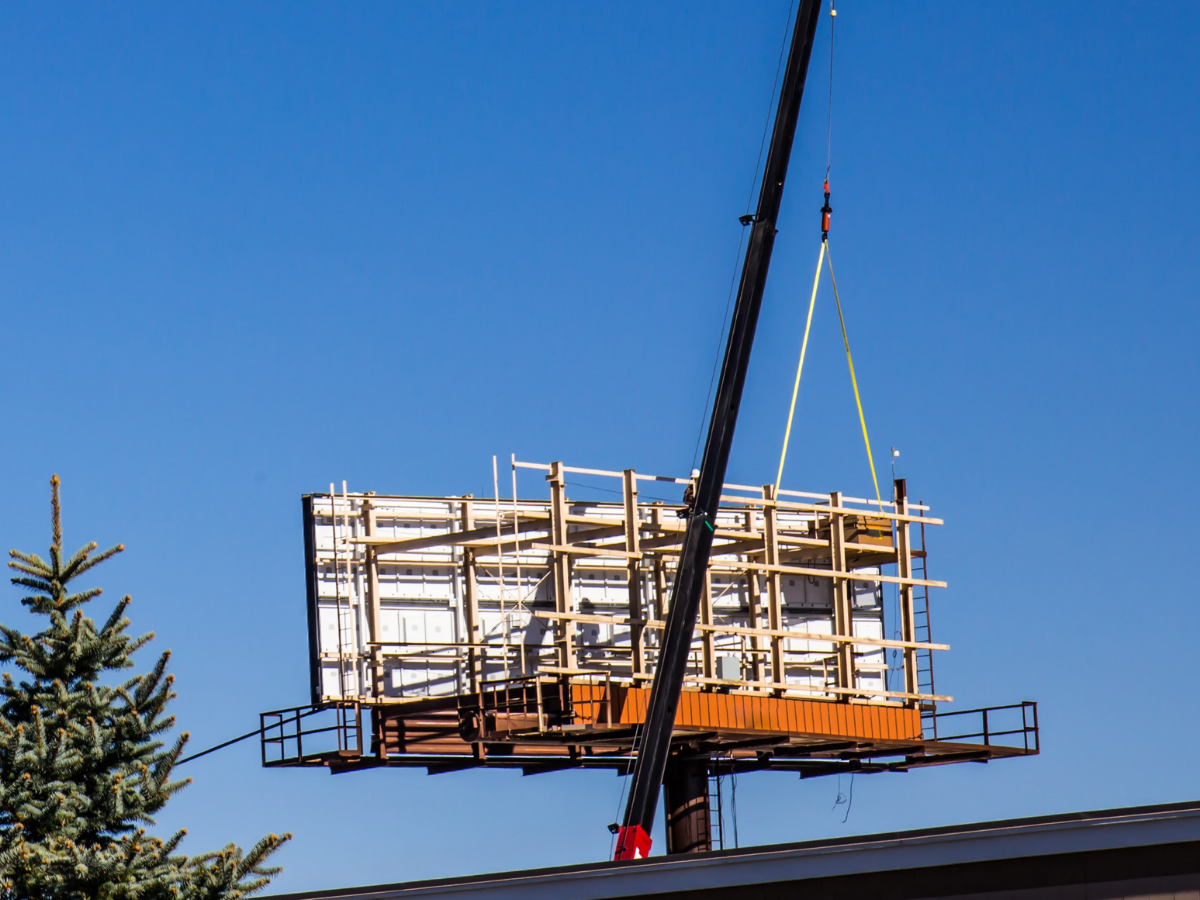
How are billboards put up physically?

When it comes to building a billboard, size, cost, materials, and design are all important considerations. A typical billboard is twelve feet high with an upper height twenty-five feet off the ground. Billboards may be anywhere from twenty-five to forty-eight feet wide. Billboards may take the form of bulletins or poster panels. Bulletin-sized ads which we normally think of as billboards may be as large as twenty feet by sixty feet.

The cost of the bulletin board is based on size and materials. Billboard costs range anywhere from ten to twenty thousand dollars.

The most commonly used material for traditional billboards is polyvinyl chloride. Polyethylene has taken the lead in recent billboard construction because it offers an attractive recyclable option.

Some billboards use computer-aided or hand-drawn messages. Thirty-sheet poster panels measure up to twelve by twenty-five feet. These are lithographed or silk-screen-printed.

Billboards often appear for thirty days. Advertising space may be rented for only a week or two before a special event and replaced the day after the event. Billboard space may also be purchased for multi-month contracts.

Technological Influences on Billboard Design

According to business2community.com technological advances have changed billboard design. Digital out-of-home advertising now accounts for over $35 billion in revenue.

Billboard advertising is increasingly smarter. Today’s billboards may show information and react to their viewers through sensors and facial recognition software.

Modern digital ads use augmented reality and other interactive technology to increase viewer engagement.

Billboards do more than show information, Bluetooth energy beacons send information based on demographics to interact with the reader. Advertisers can tweak details to appeal to specific demographics.

Integration between billboards and mobile technology allows interaction, data sharing, and customized experiences.

Thanks to technology, advertising placement is almost limitless. Digital ads can be placed on building walls, passenger shelters, buses, taxis, trains, and inside airports.

posting new billboard

Why Invest in Billboards?

There are many advantages to using your advertising budget to buy billboard space. Large and eye-catching, billboards target a huge, diverse market.

Even for those whose first language is not English, billboards offer important information about a product or service. The largely pictorial information has a strong visual effect.

People in America spend a significant amount of time in their cars. Billboard advertising has a captive audience. It isn’t dependent on their buying a newspaper, a magazine, or a tablet to view the product or service. Billboard advertising lets businesses reach more people faster and cheaper than any other form of marketing.

  • For middle and upper-class target audiences, billboards allow companies to build and strengthen their brand recognition, reputation, and product image.

Running TV and radio spot ads is very pricey. These run, at best, only a few times a day. Magazine and newspaper ads are also expensive. They cost both the business and the potential buyer and are dependent upon the customers purchasing that paper or magazine. On the other hand, the message on billboards is always working.

With other forms of advertising, potential buyers might be exposed to a brand or service just once or twice. With billboards, drivers and pedestrians have repeat exposure day after day.

A billboard’s brief message has the potential to remain in the viewer’s mind. Because it is succinct and repeated, the message is long-lasting.

How Can bMedia Group Help?

With over three hundred attention-generating locations in Puerto Rico, bMedia Group offers its valued clients a wide variety of effective billboard formats. Our skilled designers and construction staff members are masters of taking your design wants and creating effective billboards.

There is a good reason why bMedia Group has the highest consumer traffic in the area.

For more information regarding how we can increase your brand recognition contact us.

Best Super Bowl Advertisements

They are, on average, thirty seconds long. But every year, companies vie for those coveted spots. Over time, the cost of a Super Bowl advertisement has skyrocketed.

In 2018, businesses paid $5 million for a thirty-second ad. In 2020, AdAge.com pegged the cost of a single Super Bowl ad at $5.6 million.

Why are they prepared to shell out this money? Over a hundred and eleven million Americans watched the big game in 2018. The year was not unique. The Super Bowl represents 19 of the 20 most-watched TV broadcasts in American viewing history.

best super bowl advertisements

Do Super Bowl viewers even watch the ads?

Although DVR has made it possible to flash by ads, most fans watch the Super Bowl live. With live TV, most game watchers use commercial breaks to load up on Super Bowl snacks. However, according to an SI Wire survey almost 18% tune in to the glitzy advertisements.

It’s also been proven that Super Bowl commercials are viewed and shared via YouTube for quite some time after the actual game.

Super Bowl ads are a unique form of entertainment.

While most businesses cannot afford Super Bowl ads, they can learn valuable marketing lessons from the best super bowl advertisements.

What Makes the Best Super Bowl Advertisements?

According to Dan Grange of the Los Angeles ad agency Oxford Road’s seventy-one-measurement scoring system, several components must be assessed. These include things like:

  • Commercial set-up
  • Theme
  • Moral
  • Proposition
  • Intent
  • Positioning
  • Execution.

Forbes magazine notes Super Bowl broadcasting is the time when businesses get the most extensive viewership. Compare other highly-watched events like game seven of the World Series where commercials cost half a million and the 2016 Oscars where advertisements could be bought for $2 million.

A cardinal rule of a Super Bowl ad is that it convinces viewers to buy their product or increases brand recognition. Other traits that make an ad effective are its entertainment value and its likeability.

The Most Memorable Super Bowl Ads

In 2011, Chrysler paid $12.4 million for an advertisement that saw famed rapper Eminem driving a Chrysler 200 around Detroit. This ad is the most expensive in Super Bowl history. However, it increased the brand of the automobile manufacturer and the city of Detroit. Car sales grew by half and the Motor City became a renewed tourist destination.

Other memorable ads include Budweiser’s “Joust” commercial featuring Bud Knight and his medieval royal subjects who shout, “Dilly Dilly” when offered beer.

Microsoft’s “We All Win” highlights the story of their efforts to help mobility challenged individuals by launching an adaptive video game controller. The ad that shows the challenged children using Microsoft’s new adaptive video game controller gets high marks for both emotion and civic responsibility. The ad encourages clients to buy from a company that proves it cares about its customers.

Awards go to the Tide ad of 2018. The storyline has nothing to do with the detergent. However, the actors sport very clean clothes. At the end of the plot, the voice-over says, “It’s just another Tide Ad.”

Newcastle, a popular beer, launched a call to encourage brands to pool resources for one big ad. It tells the tale of a couple celebrating their new home with Newcastle beer. Their walk through the new house features other brand logos among paintings and family photos. Featured in their unpacking are appliances and entertainment devices.

The 2010 ad, “Keep Your Hands off My Doritos” tells the funny story of a narcissistic man meeting his new girlfriend’s son. The kid warns his mother’s suitor: “Keep your hands off of my momma. Keep your hands off of my Doritos!” The ad is hilarious and relatable. The catchphrase is repeatable.

In 1999, Budweiser’s award-winning commercial focuses on a man answering the phone while watching a big game. His friend asks, “Wassup?” The man responds, “Nothing. Just watchin’ the game and drinkin’ a Bud.” The man’s roommate walks in and yells, “WASSSSUPPPPP?” The phrase echoed among game-watching beer drinkers for a decade.

Pepsi’s 1996 commercial to the tune of Hank Williams’ “Your Cheatin’ Heart” depicts a Coke delivery guy helping himself to a Pepsi. The moral: Even Coca-Cola employees love Pepsi.

Apple’s 1984 ad pays tribute to Orwell’s 1984. Men are marching in straight lines. On a giant screen, the leader tells them, “We are one people, with one whim, one resolve, and one cause.” A woman wearing bright clothing and wielding a hammer explodes the screen. The ad concludes with an announcement of the Macintosh computer. The ad is a tip of the hat to Apple’s innovative ideas.

Apple’s ability to think outside the box is mirrored in Volvo’s 2015 Super Bowl ad that one-upped its competitor by giving away a car.

One of our all-time favorites is Coca Cola’s 1971 ad that features Italian hills as the backdrop of the young adults from several countries singing, “I’d Like to Buy the World a Coke.” The ad demonstrated the relatability of millions of people around the globe who enjoy Coca-Cola. The ad embraces both diversity and world peace.

Slated to be a crowd-pleaser in the 2021 Super Bowl, the Doritos ad features Old Town Road rapper Lil Nas X.

super bowl commercials

How Can Your Company Create a Memorable Advertisement?

If you check out the best Super Bowl advertisements through the decades, you will discover that they have some common features.

These advertisements tug at your heartstrings. They leave you feeling happy, sad, proud, optimistic, or hopeful. Their storylines build a lasting emotion. They make you laugh or cry. They create nostalgia.

Some of the most memorable ads acknowledged popular literature, music, or culture. Their story weaves through the life and times of America. Using the most effective technology available at the time, memorable ads help viewers relate to what is going on in the world around them.

The ads with the most appeal are ones to which viewers can relate. People celebrate family occasions. Children conquer a handicap. A boy protects his mom. People reach out to their aging relatives. Viewers know what it feels like to walk in their shoes.

We can’t all afford multimillion-dollar ads.

However, the best Super Bowl advertisements have valuable lessons.

Whether you choose to build brand recognition through TV ads, radio spots, magazine ads, or outdoor advertising, you can learn effective marketing strategies from Super Bowl ads.  

How Long Does a Billboard Stay Up?

Billboard advertising uses a large print advertisement to market a company, a brand, a product, a service, or a campaign. Billboards usually appear in high traffic areas in cities, along highways, on buses, or on building walls where they are seen by large numbers of riders, drivers, or walkers.

billboard of musical overlooking city highway

All About Billboard Advertising

We see them everywhere in every size and color. Technology has changed them but they are still an in-your-face type of advertising that not even social media can surpass. Here are some things you might not know about billboards.

They’ve been around for thousands of years—even before newspapers. An obelisk advertising a runaway slave was set up in Thebes, Egypt.

Electronic billboards are not as new as we might think, either. They’ve been around for a century. In 1904, a billboard pioneer, Oscar Gude installed the first electric sign in New York City. It advertised whiskey.

The largest billboard is in Madrid. At 5,265 square meters, it is the size of twenty tennis courts or an American football field. It weighs as much as a male hippopotamus.

New scented billboards appeal to sight and smell. A North Carolina grocery store billboard erected a “smellvertising” billboard with a grilled steak aroma.

Research shows that we may be exposed to as many as four thousand ads each day. An Arbitron study found that nearly three in four viewers notice ads and read them

blank digital billboard

The Power of Billboard Advertising

Advertising on Billboards: How Much does it Cost?

Many factors determine the cost of billboard advertising. These include the size of the billboard, its location, traffic volume in the area, and estimated viewership Billboard advertising costs are usually monthly. They may range from $250 on a rural highway to $22,000 in New York’s Times Square.

The world’s most expensive billboard is in Times Square. Google paid $2.5 million to rent the billboard for its debut. The cost was $625,000 a week. That’s 125 times the average NYC billboard rental. Times Square’s daily traffic is 300,000 people. Google’s billboard was viewed by nine million tourists and New Yorkers that month.

Along with the cost of the space rental, you need to consider the cost of ad design, the creation of the billboard-size advertisement, and the cost of installation.

A successful billboard can be read and appreciated as you pass by. Moreover, it takes viewers on a four-second journey. Since drivers can read only a few words in passing, the message must be the essence of an idea. Text-less messages can be powerful.

Effective billboards interact with their surroundings. Their bright colors and eye-catching graphics build brand recognition and elicit an emotion from the viewers. This is emotional marketing. The best ones for 2019 were selected by Edina

New Trends in Billboard Advertising

Urbanization continues to grow. Thus, billboards will expand, enlarge, and become more technically attention-getting.

More billboards will be digital.

There is a trend toward more interactive billboards. Advertising spaces will be increasingly responsive and flexible towards audiences. These new interactive billboards will present the niche market with personal, engaging messages based on information about their habits, interests, and consumer preferences.

New trends will focus on the consumer—what he wants; what he needs; his shopping times; product appeal.

fashion billboard next to old building

What Goes into a Billboard Advertising Decision?

Thanks to digitalization, billboards have become effective advertising tools of the twenty-first century.

Billboards provide multiple “touches”. The number of exposures is important when attempting to convert viewers to buyers.

With billboards, you have a captive audience of riders and walkers in high traffic areas. TV viewers can speed past commercials. Those slick, costly magazine and Internet ads often go unnoticed.

When an individual decides to advertise on billboards, many things determine this decision. Companies have specific goals for their advertising. They want to get the most exposure for their limited advertising budget. They weigh the odds of how many in their niche market will see a billboard, remember its message, and want to find out more about the product or service. 

Biggest takeaways from billboards

  • Billboards are huge. Thus, by their very size, they command attention.
  • For small businesses with limited advertising dollars, billboards are effective.
  • Billboards reach a widely diverse viewership.
  • Billboards can deliver results—if the conditions are right circumstances.
  • The average American spends almost an hour a day driving or riding.
  • Three in five Americans learned about an event, a restaurant, a product, or service on a billboard. Of those, three in five later visited the location.
  • Even expensive billboards deliver a lower cost per impression when you calculate how many people see them.

How Long Does a Billboard Stay up?

There is no one right answer to this question. It depends on several things. Is the billboard still generating new customers? What are your campaign goals? Do you have the budget to continue paying for this ad? Have you measured your return on investment? Are you getting your money’s worth?

If you are advertising an event, the billboard is time-sensitive. After the event, you are wasting your advertising dollars leaving it up.

Is it time to make a change to another location where more of your target market will see your ad? Have you considered switching to a larger ad? Is it time to go digital?

Have you thought about a building wall ad, a bus side ad, or a bench ad?

A general rule is that billboards stay up at least one month. Many campaigns are up for several months.

If you have decided that billboards are right for your company, check out the outdoor advertising information.