
Out-of-the-Box Marketing Ideas

When it comes to marketing, most people think that you need an army of promoters, designers, and developers to launch a successful marketing campaign. But that’s not true.

All marketing is, is about creating a strategy, identifying your target audience and then executing it in a way that resonates with them, and that is no different than with out-of-home advertising such as billboards.

It can be a difficult process to get right but one of the best things about it is the opportunity for creativity and innovation along the way.

So, if you’re looking for some inspiration on how to do just that, we can help! We have put together this list of our favorite out-of-the-box marketing ideas that will help you stand out from the crowd and win customers over before they even know what hit them.

marketing ideas

What is An Out-of-Box Marketing Strategy?

Out of the box marketing comes down to one thing – data-driven marketing with emerging strategies.

For instance, if you choose to buy a placement on a billboard, using data technologies that measure traffic and the prospective reach is one thing, but merging that with custom URLs, hashtags, or QR codes creates an ecosystem that propels brand awareness and experience.

Below are ten out of the box marketing ideas that can help benefit you and your business.

Offer a Trade

If you have a product that has value and your customers don’t want it, they’ll probably be willing to trade something else instead. This is a great way to get rid of products that are too expensive to distribute or not selling well.

There are many ways you can offer trades:

  • Trade-in credit: Offer customers the option of trading in their old product for store credit toward future purchases. This can be especially useful when selling electronics or other expensive items that require replacement parts or repairs regularly.
  • Gift card swap: You could give out gift cards at the checkout counter when someone makes a purchase, but then offer them the option of also receiving an extra gift card for every item they trade in as well! This could double or triple your return on investment (ROI) from these discounted sales because people will actually buy another item with their first credit rather than just leaving empty handed—which happens more often than not when companies only offer one type of payment option during checkout processes like this one does.

digital marketing ideas

Use Digital Signage

Digital signage is the use of digital technology to promote products, services, events and brand messages on large displays in public locations – such as stadiums, shopping malls and terminals.

Digital signage serves a number of purposes including:

  • Promoting your business
  • Providing information to customers on where they can find what they’re looking for or what is happening in the area

Create a Scavenger Hunt

This is a great way to get your team or clients involved and increase brand awareness/loyalty.

Create a list of items, then take pictures or video of them in your office and store it online or across social media so your participants can see them.

On the day that you launch your scavenger hunt, send out an email with instructions for how to participate (you can also post on social media if you have room for more exposure). The instructions should include what image(s) are needed from each location, how participants will know when they’ve found the item(s) needed and other details like this one: “The first person who finds [an item] at [location] wins!”.

Make sure the prizes are worth winning! It’s always good to give away something that has value because it shows appreciation towards those who took time out of their busy days in order to participate. The prize doesn’t have to be big though; it just needs something special about it so people feel good about themselves after receiving one as opposed to feeling like they’re just some dumb loser who couldn’t find anything cool enough.

Use the Mail

  • Use the mail to send coupons, information about your business or products, and thank you cards.
  • Send holiday cards to customers, friends, and family that have expressed interest in your business.
  • Send birthday cards for every employee, including yourself! It’s important for employees to feel connected to the company beyond just working together on projects.

Go Mobile With Mobile Coupons or QR Codes

Using billboards or fuel pump advertising allows the use of QR codes.

QR codes saw a resurgence during the 2020 COVID lockdowns, and the momentum has not stopped.

QR codes can offer mobile coupons that are a great way to reach your audience and get them into your store. They can also be used in many ways. For example, you could offer free shipping on a certain day or time period, or coupons for discounts on items in your store. Mobile coupons are also helpful for getting people to try new things, like offering free samples at checkout counters.

Create a Viral Marketing Campaign

When you think of your content, don’t limit yourself to what’s on the paper in front of you.

Think about how you can add value to that content. For example, in a recent film “Smile”, the marketing team sent paid actors to baseball games to ‘Smile’ for the duration. The goal was to raise awareness but also to creatively expand the audience in a viral marketing effort.

Viral marketing combines out of home marketing with digital marketing and PR to produce word of mouth awareness.

Host an Event at Your Place of Business

Hosting an event at your business is a great way to get your brand in front of your customers. For example, if you’re a barber shop or salon, you can host an event where people come in for discounted haircuts. This is also a great way to build brand loyalty and engage with customers on a deeper level.

You don’t have to hold the event at your place of business either! You could host it off site and encourage people from all over town or even around the world to attend. This gives them something fun and entertaining while also bringing more traffic into your store or office space.

Give Away Swag

Gifting swag is a great way to get your name out there. The trick is to give away something that’s relevant to your business, useful for the customer, and not too expensive. A good example of this is offering an in-store coupon when people bring their pets in for grooming.

You should also try gifting things that will get people talking about your brand and put you at the forefront of their minds — like branded water bottles or reusable totes!

Go ‘Live’ on Social Media Platforms

Live video is a great way to connect with your audience. It’s a great way to show off your products, new or old. You can use live video to promote a new product or service, share information about your company, and even answer questions from people who are interested in what you have to offer.

Get Local Businesses Involved in a Larger Campaign

  • Think about how you can work with other businesses in your area.
  • Get them involved in a larger campaign, and ask them to promote your business for free.
  • Offer them a free service in return for their support.
  • Offer them a discount on one of your services or products if they agree to help promote it through their own channels (e.g., website, social media).
  • Give away free gifts to people who attend events at another business’s location (e.g., restaurant) as part of an event of yours that’s happening nearby—this could be tickets or gift certificates that they can use on their next visit!

marketing strategy session

Think Outside the Box for Creative Marketing Ideas

The best way to get creative marketing ideas is to think outside the box. If you are getting stuck on a project and need some inspiration, here are some ways to help you come up with unique ideas for your business:

  • Get on the internet! There are so many websites out there that provide excellent resources when it comes to searching for creative marketing ideas. There are also plenty of blogs and articles written by successful entrepreneurs who have used these techniques before.
  • Use what works! If an idea worked well in the past, there’s no reason why it won’t work again! Don’t be afraid of trying something again if enough time has passed since its initial success; after all, nothing beats experience when it comes down to figuring out how effective certain techniques can be at generating interest among potential customers.
  • Survey your audience! Go right to the source and ask what they want to see more of from your business or brand.

bMedia and Out-of-the-Box Marketing Ideas

Out of the box marketing ideas come in many shapes and sizes. While viral marketing worked for the team promoting a film, it’s best to consider your options, keep an open mind, and find a partner that can help you achieve your KPIs.

As a local leading media promotion company, our goal is to provide advertising avenues that make your message get through to your target market in order to solidify your brand image and / or increase your sales through impact, quality, innovation, and distinct services. We’re

Contact bMedia and learn more about our services and how we can help promote your business.

Effective Advertising Strategies

For over a century, billboards have remained a popular and effective advertising medium, capturing the attention of countless passersby with their large-scale and prominently displayed ads. Despite the rise of digital advertising, billboards have not only survived but also evolved. These days, billboards are equipped with digital technology and innovative designs that make them even more impactful and relevant than before.

Effective Advertising Strategies rely on understanding the potential of the medium and leveraging it to its fullest. For business owners, billboard advertising presents an unparalleled opportunity to showcase their brand message to a broad audience, ensuring that it stays in their memory. While digital ads come and go, billboards are a physical presence that commands attention and leaves a lasting impression.

Billboard advertising is not just about size; it’s also about strategy. To make the most of billboard advertising, businesses must convey their message effectively, resonate with their target audience, and drive action. Understanding the nuances of billboard advertising is crucial for business owners who want to make a mark in the market. In this regard, we’ll delve deeper and explore how billboards can be a game-changer for businesses, especially in dynamic markets like Puerto Rico.

Effective-Advertising-Strategies

Most Effective Advertising Strategies

In the realm of business, understanding your audience is paramount. The foundation of any effective advertising strategy is built upon the principle of targeting. By honing in on a specific demographic, businesses can tailor their message to resonate more deeply with potential customers. A well-targeted advertisement speaks directly to the viewer’s needs, desires, and aspirations, making it far more impactful than a generic message.

According to an article on Spiceworks, social media profiles offer a significant opportunity for target marketing. Brands can pinpoint customers based on various factors, including their interests, behavior, and demographics. This targeted approach ensures that the advertising message reaches the most relevant audience, increasing the likelihood of engagement and conversion.

However, it’s not just about reaching the right people; it’s about conveying the right message. The essence of effective advertising strategies lies in crafting a message that not only captures attention but also drives action. Whether it’s evoking an emotion, solving a problem, or fulfilling a need, the advertisement should offer tangible value to the viewer.

Moreover, in the ever-evolving landscape of advertising, it’s crucial for businesses to stay updated with the latest trends and technologies. From leveraging data analytics to employing innovative design principles, the strategies that worked a decade ago might not be as effective today. Thus, continuous learning and adaptation are key to ensuring that your advertising efforts yield the desired results.

Benefits of Billboard Advertising in Puerto Rico

Puerto Rico, with its dense population and unique market dynamics, presents a golden opportunity for advertisers. The island, spanning just over 100 miles in length, is home to over 3.5 million people. This concentration results in a significant traffic scenario, especially considering there are over 3 million registered vehicles on the island. While traffic might be a commuter’s nightmare, it’s a dream come true for advertisers. The reason? Billboards.

The severe traffic situation in Puerto Rico offers a plethora of opportunities for advertisers aiming to capture the attention of motorists. In an era where digital advertising is rapidly evolving, traditional forms like billboards remain steadfast. As long as people continue to drive, billboard marketing and other outdoor media will remain an influential platform for advertising.

The main point in such a scenario is to capitalize on the captive audience. Motorists, often looking for distractions during traffic snarls, are more likely to engage with and remember billboard advertisements. This captive audience, combined with the strategic placement of billboards, ensures that the advertising message is not just seen but also makes a lasting impression.

Furthermore, billboard advertising in Puerto Rico offers an inherent demographic control. The majority of the viewers are likely commuters heading to their workplaces, implying they have the financial means to own a vehicle. This ensures that the advertisement reaches an audience that falls within a specific economic demographic, making the message more targeted and effective.

most-effective-advertising-methods

Designing Impactful Billboards

The art of billboard design is a delicate balance between creativity and clarity. While it’s essential to have an eye-catching design, the primary objective remains to convey a message effectively. Given that commuters typically have only 5-10 seconds to read a billboard as they pass by, the design must be concise, clear, and compelling.

The key to effective billboard design is brevity. The human capacity to ingest and remember a message in a fast-paced environment like traffic is limited to about seven words. Overloading a billboard with too much content can dilute the message and reduce its impact. Therefore, brands must be judicious in their choice of words and visuals.

The critical aspect in billboard design lies in understanding the medium’s constraints and strengths. Here are some principles to consider:

  • Simplicity is Key: A clutter-free design with a clear focal point ensures that the message stands out. Avoid the temptation to include too many elements.
  • Bold and Legible Fonts: Choose fonts that are easy to read from a distance. Avoid script or decorative fonts that might be challenging to decipher at high speeds.
  • High-Contrast Colors: Colors play a crucial role in visibility. Opt for colors that contrast well, ensuring that the text stands out against the background.
  • Relevant Imagery: Use images that resonate with the message and the target audience. The imagery should support and enhance the message, not overshadow it.
  • Call to Action: While not always necessary, a clear call to action can guide the viewer on the next steps, whether it’s visiting a website, making a call, or attending an event.

Strategy Marketing: Measuring Effectiveness

In the realm of billboard advertising, understanding the impact of your campaign is paramount. After all, how do you determine if your investment is yielding the desired results? Measuring the effectiveness of billboards is not as straightforward as digital ads where clicks and impressions are easily tracked. However, with the right strategies, one can gauge the success of their billboard campaigns.

According to a detailed article on bMedia Group, there are several methods to measure billboard effectiveness:

  1. Traffic Analysis: It’s essential to understand the traffic surrounding the location of a billboard. Factors such as the number of people or vehicles that pass by daily can provide insights into the potential visibility of your advertisement.
  2. Analytics: If your billboard promotes a unique slogan, catchphrase, or brand name, you can use analytics data scraping methods to analyze how often those terms are searched online. An uptick in searches can indicate increased visibility and interest due to the billboard.
  3. Hashtags: Modern advertising often incorporates hashtags. If your billboard includes a specific hashtag, monitoring its usage on social media platforms can provide insights into the ad’s reach and engagement.
  4. Sales Analytics: A direct correlation often exists between sales and outdoor ads. Monitoring sales or profit benchmarks can help determine if a new billboard ad is driving more customers to your business.
  5. Audience Impact: The daily commute is a significant idle time for many individuals. Billboards strategically placed in high-traffic areas can garner a captive audience, leading to higher brand recognition and recall.

The Role of Local Culture and Context in Billboard Advertising

In the vast world of advertising, understanding the local culture and context is paramount. Effective advertising strategies are not just about reaching a wide audience but resonating with them on a personal and cultural level. Here’s why:

  • Cultural Sensitivity: Every region has its unique cultural nuances, traditions, and values. Respecting and incorporating these into your billboard messages ensures that your ads are not only seen but also felt by the local audience.
  • Localization vs. Globalization: Global campaigns have their merits, but there’s a distinct advantage in tailoring billboard content to local tastes and preferences. It creates a sense of belonging and trust among the local audience.
  • Use of Local Icons and Symbols: Featuring familiar local landmarks, celebrities, or cultural symbols can make billboards more relatable. It’s a subtle nod to the community, indicating that you understand and value their culture.
  • Language and Dialects: Using the local language or specific dialects can significantly enhance the relatability of a billboard. Especially in regions with linguistic diversity, this can make a world of difference.
  • Seasonal and Event-Based Billboards: Leveraging local festivals, holidays, or events can make billboard advertising timely and relevant. For instance, a billboard highlighting a product during a local festival can attract more attention and sales.

most-effective-advertising-strategies

Summary of Effective Advertising Strategies

In the dynamic world of advertising, understanding and implementing effective strategies is crucial. Here’s a concise summary of the key takeaways:

  • Audience Understanding: Delve deep into demographics and behaviors to craft messages that resonate with the target audience.
  • Personalization: Tailor ads to align with individual preferences, ensuring higher engagement and conversion rates.
  • Leveraging Technology: Use advanced tools and platforms to optimize ad delivery, ensuring timely and relevant reach.
  • Multi-Channel Approach: Integrate both online and offline strategies for a synergistic effect, maximizing reach and engagement.
  • Creativity is King: Ads that stand out with their narrative and visual appeal foster better brand recall and engagement.
  • Billboard Advertising: Despite the digital surge, traditional mediums like billboards remain effective. Insights from other articles also highlight the resurgence and effectiveness of billboard advertising.

In essence, the success of advertising lies in a blend of data-driven insights, creativity, and strategic deployment across various channels.

Types of Outdoor Advertising

Advertising has been around for centuries but has taken many different shapes and forms. Today, there are many different types of advertising available for businesses, including types of outdoor advertising.

types of outdoor advertising

What is Outdoor Advertising?

Business Encyclopedia defines outdoor advertising as advertising that reaches potential buyers when they are outside their homes. Outdoor advertising is sometimes referred to as out-of-home advertising.

How Prevalent is Outdoor Advertising?

Many successful companies have discovered that outdoor advertising is their most effective means of getting their brand known and generating traffic to their businesses. For example, Cracker Barrel spends almost half of its advertising dollars on outdoor advertising (you’ve probably seen one or two while exiting the freeway).

Why Invest in Outdoor Advertising?

The Outdoor Advertising Association of America shows studies that potential American consumers spend seventy percent of their time outside their homes. Thus, it makes sense to present advertising in this environment.

A Nielson study featured in Entrepreneur discovered that outdoor advertising is the most effective non-digital method of generating traffic to online sales.

Outdoor advertising has the greatest return on investment in any form of advertising. On average, each dollar invested in outdoor advertising sees an almost triple return on investment. This is more than TV and magazine ads combined.

outdoor advertising types

Types of Outdoor Advertising

When we think of out-of-home advertising, three that immediately come to mind are billboards, transit advertising, and street furniture. However, technological advances and creative advertising artists have invented several others.

  • Billboard Advertising

Billboards are the most common form of outdoor advertising. They come in various sizes. They range from static to digital, or mobile. Thanks to new technology, some of the newer ones use augmented reality. Some are interactive.

Billboards’ effectiveness in name recognition and buyer enticement is high. One disadvantage of billboards is that viewers who are walking or driving by them see them for only a few seconds. Thus, the message must be one potential buyer can grasp in that short time. Billboards provide no avenue for longer advertising copy.

With billboards—like real estate—their effectiveness depends on location. Billboards must be placed where traffic patterns and sightlines allow them to be seen by large numbers of passersby.

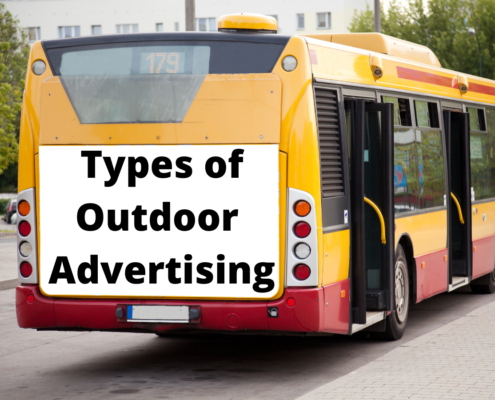
  • Transit or Vehicle Advertising

This type of out-of-home advertising includes signs and images on the interior and/or exterior walls of buses, railway cars, taxis, subway cars, and transit shelters.

The advantage is that these surfaces have a captive audience. However, people using public transit are often anxious about missing connections and reaching their destination on time. They are not in the best frame of mind to read advertising copy.

  • Street Furniture

Street furniture has the advantage of being relatively inexpensive. It is placed at eye level for foot traffic and can be very eye-catching. Because the traffic is mostly pedestrians and bikers, more advertising copy can appear on street furniture than on billboards or transit advertising.

Street furniture advertising may be static or digital. There are many opportunities including park benches, bus shelters, bike shares, urban panels, and metro lights.

Street furniture advertising can target the residents of specific neighborhoods, providing unique media opportunities to showcase local vendors.

  • Construction Advertising

Sides of buildings, fences, doors, windows present opportunities for advertisers similar to those offered by street furniture. Advertisers can target both pedestrians and drivers with their local and regional messages. Technology has increased the sophistication of these static and digital signboards.

  • Mobile Advertising

Millions of Americans now take handheld devices and smartphones wherever they go.

Mobile advertising includes advertising on mobile phones and other mobile devices. Mobile advertising can take place as text ads via SMS, or banner advertisements that appear embedded in a mobile web site.

Mobile advertising also makes use of social media like Facebook, Twitter, and Instagram to send brand recognition and special events messages to targeted audiences.

  • Augmented Reality

Augmented reality advertising creates an interactive experience of a real-world environment through computer-generated sensory stimulation. Augmented reality may be used to enhance several forms of outdoor advertising including billboards.

  • Static Advertising

Static advertising includes images or banners that target or retarget specific audiences. Because they are stationary or permanent, static advertising is easily maintained. They need to be assembled only once. So, they are relatively inexpensive in both time and labor. The effectiveness of static ads is easily monitored.

  • Interactive Advertising

Interactive advertising utilizes online or offline interactive media. Its aim is to communicate with consumers. Interactive ads promote products, advance brand recognition, inform would-be buyers about goods and services, or provide public announcements about special events.

  • Point of Sale Advertising

According to the Cambridge Business English Dictionary, point of sale advertising is also known as point of purchase advertising. It includes any advertising of goods or services at the location where they are sold. This would include ads outside storefronts, restaurants, fast food specials, store window displays, and chalkboard signs.

The advantage is that these advertisements of products, sales, or special events entice pedestrians into the establishment.

  • Retail Advertising

Retail advertising or retail marketing includes retailer store advertising both online and offline. The goal is to increase awareness and interest in products or services. Retail advertising is successful if it generates sales from a target audience. Through retail advertising, storeowners attempt to influence their audience into malls, shopping centers, stores.

  • User-Generated Advertising

With increasing technology, there is a rapidly growing trend toward user-generated content. This media content is generated by customers. It is disseminated in various social media forms including Facebook, Twitter, and YouTube.

Marketers interface with customers to encourage them to share the business, its services, and their positive experiences with the products. They may be enticed to provide reviews by offering discounts, opportunities to try new products, loyalty points, or other incentives.

types of advertising

How to Get Started

Outdoor advertising revenue has been steadily growing since 2009. In 2019, revenue from outdoor advertising amounted to over eight and a half-billion dollars in the United States.

If you have decided to pursue outdoor advertising campaigns, there are several things you need to consider.

  • What types of out-of-home advertising will bring your products and services the best return on investment?
  • What advertising copy or campaign will stand out from your competition?
  • Given your objectives, what are prime locations for your outdoor ads?
  • Having analyzed the competition, what is the best use of your advertising budget?

For information on these important questions, talk to experienced, proven outdoor advertising specialists like bMedia.

Using our expertise, you can create simple, powerful outdoor advertisements for your company.