Outdoor Advertising Screens

[av_section min_height=” min_height_px=’500px’ padding=’default’ shadow=’no-shadow’ bottom_border=’no-border-styling’ bottom_border_diagonal_color=’#333333′ bottom_border_diagonal_direction=” bottom_border_style=” id=” color=’main_color’ custom_bg=” src=” attachment=” attachment_size=” attach=’fixed’ position=’center center’ repeat=’stretch’ video=” video_ratio=’16:9′ overlay_opacity=’0.5′ overlay_color=” overlay_pattern=” overlay_custom_pattern=”]

[av_one_full first min_height=” vertical_alignment=’av-align-top’ space=” custom_margin=’aviaTBcustom_margin’ margin=’0px,20px’ padding=’0px’ padding_sync=’true’ border=” border_color=” radius=’0px’ radius_sync=’true’ background_color=” src=” attachment=” attachment_size=” background_position=’top left’ background_repeat=’no-repeat’ animation=” mobile_display=”]

[av_button label=’Leer en Español’ link=’page,954′ link_target=” size=’medium’ position=’left’ icon_select=’no’ icon=’ue800′ font=’entypo-fontello’ color=’custom’ custom_bg=’#dd3333′ custom_font=’#ffff00′]

[/av_one_full][av_textblock size=” font_color=” color=’#ffffff’ av-medium-font-size=” av-small-font-size=” av-mini-font-size=” av_uid=’av-k8f59u4b’ custom_class=” admin_preview_bg=”]

As far as types of billboard advertising go there are three main classes that make up the industry for outdoor advertising screens: Static, Digital & Prismavision

Most people can intuitively decipher what static and digital outdoor advertising screens represent so we are going to discuss the latter of the three, Prismavision billboards. Prismavision is often referred to as the “three-message sign.” Why? Well, Prismavision’s name comes from the way it works “Prismavision”  which uses prisms to display content, other names for Prismavision include Prismatic Display, Trivision, Three Message Sign, Tri-Face or VMS’s (Variable Message Sign).

Different Types of Outdoor Advertising Screens

Many may think of outdoor advertising as simple poster billboards displayed near roadways and high trafficked areas. While this is true, businesses should note that outdoor advertising has come a long way. With the new digital era, there are various types of outdoor advertising screens that can really enhance the overall message and provide effectiveness for increased return on investment. Outdoor advertising agencies, such as bMedia Group, can give clarity to business for the best types of advertising. In general, different types of screens include:

  • Static – As one of the most effective forms of advertising, static billboards support businesses 24/7 with around-the-clock exposure for wide viewership. As static images, they do not change and remain a constant for a business display.
  • Digital – Utilizing LED lights and timers, digital billboards offer versatility as they can be frequently updated or changed. Measuring effectiveness and readjusting is much more simple than with a static billboard.
  • Prismavision – As an alternative to static and digital, prismavision billboards are made of aluminum and can alternate between ads much like digital. Businesses can create multiple advertisements or messages within one outdoor media ad. It also stays in place for longer than digital ads.

bMedia Outdoor Advertising Options

Puerto Rico outdoor advertising agency, bMedia, offers multiple forms of outdoor advertising options. Whether you’re looking for effective signage in static formats, or looking to go digital, we can help sort through the best mediums. In addition, we also offer prismavision, which is still a widely go-to source for businesses looking for better outdoor advertising in Puerto Rico. Contact us today to learn more about our advertising services.
[/av_textblock]

[av_toggle_container initial=’0′ mode=’accordion’ sort=”]
[av_toggle title=’How Prismavision Works’ tags=”]
Prismavision billboards consist of long vertical triangular prisms that are skewered by a rotatable poll. These polls pivot 120 degrees to show a new message each time.
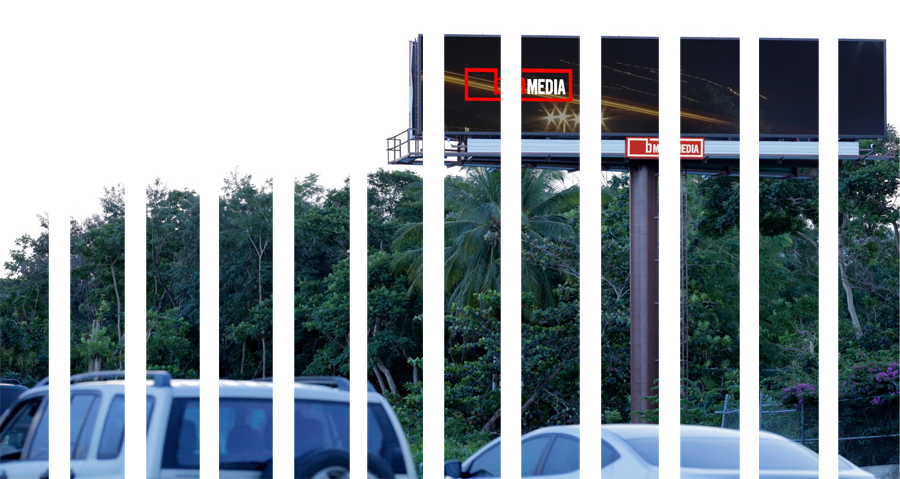
In order to display a unified message, one large image is split into multiple slits that all piece together on one side of the prism in order. These vertical slits placed together make up the large image as you see in the image below:

prismavision
Each of the three sides has a new image and message across it. The rotatable poll allows for each new message to be displayed based upon a predetermined time interval. All of the prisms will rotate to the right or the left in order to present the new combined image slits marketing message.
[/av_toggle]
[av_toggle title=’The Advantages of Prismavision’ tags=”]
The clear advantage of the Prismavision is its ability to host three different messages on one billboard traffic location. This is desired as it decreases the cost of the hosted billboard ad as well as offers creative marketing opportunities.

One creative use is to purpose the rotation to display a message in the morning, afternoon and night. For instance, McDonald’s could display its Egg McMuffin on the way to work in the morning and its Big Mac at lunch. Another application could be to build a message by using all three in chronological rotation. This tactic allows you to engage the viewer for longer and display more information than on static outdoor media.

The Prismavision’s rotational movement does more than just allow for multiple messages to be displayed. This rotation catches the attention of the viewers and has been proven to increase the impact of the message’s awareness. The billboards movement also builds anticipation as the new message unveils itself to the public. In a world where digital imagery is becoming routine Prismavision can help to stand out from the crowd with its unique mechanical intrigue.

While Prismavision’s practical implications are still very current in today’s billboard marketing landscape it is not a new invention by any means. In fact, the first patent for a motorized display dates back to the very beginning of the 1900’s – over 110 years ago!

Prismavision is an undoubtedly great way to cut costs and grab people’s attention, but it is not boasted as the most common form of billboard advertising. Prismavision billboards can be very hard to come by especially on the island of Puerto Rico. But you’re in luck!

bMedia has two Prismavision Billboards on the island that you can chose from to promote your brand’s message. You can decide to purchase all three sides or cut your promotional costs by just acquiring one of them. See below for more details.
[/av_toggle]
[/av_toggle_container]

[av_hr class='invisible' height='25' shadow='no-shadow' position='center' custom_border='av-border-thin' custom_width='50px' custom_border_color='' custom_margin_top='30px' custom_margin_bottom='30px' icon_select='yes' custom_icon_color='' icon='ue808' font='entypo-fontello']

[av_heading heading='Our Prismavision Billboards' tag='h1' link_apply='' link='' link_target='' style='blockquote modern-quote modern-centered' size='' subheading_active='' subheading_size='15' margin='' padding='10' color='' custom_font='#ffffff' custom_class='' admin_preview_bg='' av-desktop-hide='' av-medium-hide='' av-small-hide='' av-mini-hide='' av-medium-font-size-title='' av-small-font-size-title='' av-mini-font-size-title='' av-medium-font-size='' av-small-font-size='' av-mini-font-size=''][/av_heading]

[av_hr class='invisible' height='25' shadow='no-shadow' position='center' custom_border='av-border-thin' custom_width='50px' custom_border_color='' custom_margin_top='30px' custom_margin_bottom='30px' icon_select='yes' custom_icon_color='' icon='ue808' font='entypo-fontello']

[av_one_half first min_height='' vertical_alignment='' space='' custom_margin='' margin='0px' padding='0px' border='' border_color='' radius='0px' background_color='' src='' background_position='top left' background_repeat='no-repeat' animation='' mobile_display='']

[av_heading heading='Expreso PR-52' tag='h2' link_apply='' link='' link_target='' style='blockquote modern-quote modern-centered' size='' subheading_active='' subheading_size='15' margin='' padding='10' color='' custom_font='#ffffff' custom_class='' admin_preview_bg='' av-desktop-hide='' av-medium-hide='' av-small-hide='' av-mini-hide='' av-medium-font-size-title='' av-small-font-size-title='' av-mini-font-size-title='' av-medium-font-size='' av-small-font-size='' av-mini-font-size=''][/av_heading]

[av_image src='https://www.bmediagroup.com/news/wp-content/uploads/2016/12/Screenshot_120216_052145_PM-e1480725256966.jpg' attachment='943' attachment_size='full' align='center' styling='' hover='' link='' target='' caption='' font_size='' appearance='' overlay_opacity='0.4' overlay_color='#000000' overlay_text_color='#ffffff' animation='no-animation'][/av_image]

[av_textblock size='20' font_color='' color='#ffffff']

FORMAT: PRISMAVISION

Visibility: 105K
Dimensions: 14′ x 48′
Resolution: 300DPIs
Color: CMYK
[/av_textblock]

[/av_one_half][av_one_half min_height='' vertical_alignment='' space='' custom_margin='' margin='0px' padding='0px' border='' border_color='' radius='0px' background_color='' src='' background_position='top left' background_repeat='no-repeat' animation='' mobile_display='']

[av_heading heading='Expreso PR-53' tag='h2' link_apply='' link='' link_target='' style='blockquote modern-quote modern-centered' size='' subheading_active='' subheading_size='15' margin='' padding='10' color='' custom_font='#ffffff' custom_class='' admin_preview_bg='' av-desktop-hide='' av-medium-hide='' av-small-hide='' av-mini-hide='' av-medium-font-size-title='' av-small-font-size-title='' av-mini-font-size-title='' av-medium-font-size='' av-small-font-size='' av-mini-font-size=''][/av_heading]

[av_image src='https://www.bmediagroup.com/news/wp-content/uploads/2016/12/Screenshot_120216_052228_PM-e1480725201845.jpg' attachment='944' attachment_size='full' align='center' styling='' hover='' link='' target='' caption='' font_size='' appearance='' overlay_opacity='0.4' overlay_color='#000000' overlay_text_color='#ffffff' animation='no-animation'][/av_image]

[av_textblock size='20' font_color='' color='#ffffff']

FORMAT: PRISMAVISION

Visibility: 95K
Dimensions: 14′ x 48′
Resolution: 300DPIs
Color: CMYK
[/av_textblock]

[/av_one_half][/av_section]
Evolution of Outdoor Advertising

Outdoor advertising isn’t a new marketing method. In fact, it’s been around since ancient times. The earliest outdoor advertising methods were chiseled on monuments in ancient cultures- including in Ancient Egypt! Hieroglyphics have been found describing laws of the country. Travelers were meant to stop and learn the rules of the civilization before entering. In this way, it can be described as an early form of outdoor advertising.

However, actual billboards as we know them didn’t evolve for many more centuries. Let’s take a look at a brief history of the evolution of outdoor advertising and where the industry is headed today.

Outdoor Ads Evolution

Early Forms of Advertising

Many people have heard of the famous Gutenberg press. Johannes Gutenberg invented the movable type printing in 1450. He was most likely influenced by primitive examples from China, Japan, and Korea. These traveled by traders along the Silk Road to Europe cultures. His inspired invention, the Gutenberg Press, rang in modern forms of advertising as we recognize them today!

In particular, handbills became very popular. Handbills, which were exactly what they sound like, were leaflets with advertising information handed out. They can be likened to early versions of newsletters!

In 1796, the first major form of outdoor advertising emerged- the illustrated poster. Using lithography, companies could create large numbers of posters for advertisement to be hung in storefronts, store windows, and even street corners.

Primitive Billboards

Primitive versions of billboards have been in use for centuries. The most common example would be posted by trails to notify travelers of an inn ahead. Travelers on foot, horseback or being pulled in a carriage would learn how far the inn was ahead, as well as what they had to offer in the way of amenities.

Posted signs along the roadside served the purpose to aid travelers to find food and shelter rather than advertising many types of goods that are found today. Widespread advertising using billboards didn’t become popular until the invention of the car.

Evolution of Outdoor Advertising

Automobiles & Outdoor Advertising

As automobiles were created and boomed, pioneering marketers realized that there was a prime opportunity to use long stretches of road to advertise products. After all, automobiles encouraged travel and mobility. This, in turn, created a need to inform travelers of what they could expect from landmarks, attractions, and hospitality on the road ahead.

Advertisements lauding local sights, national parks, and curiosities sprang up just before towns in an attempt to encourage travelers to stop and spend their money in town. Restaurants and hotels quickly followed suit, creating a real demand for enticing designs that drew travelers into a town.

Bigger Becomes Better

Billboards and outdoor advertisements had to grow larger and larger over the years for an interesting reason. As motor vehicles evolved and gained speed, advertisers needed to make their billboards bigger in order to be seen from further away! If advertisers didn’t make their billboards big enough, the motorist would zoom past their sign without being able to read it!

However, bigger didn’t mean better to everyone – in particular, the United States Government. In the 1960’s, President Lyndon B. Johnson introduced the Highway Beautification Act, which prevented billboards from overtaking America’s roadways. This legislation was passed in an effort to check outdoor advertising companies from blocking America’s scenic landscape with various advertising.

Digital Technology Changes the Game

Prior to digital technology, meticulously handpainted billboards were the norm. However, beginning in the 1990s, computer-painted and printed materials became standard. More recently in the first decade of the 2000s, LED lighted and completely digital billboards have become popular. Technology has allowed smart sensor billboards or even billboards that scroll through several images in a minute.

Outdoor Media Evolution

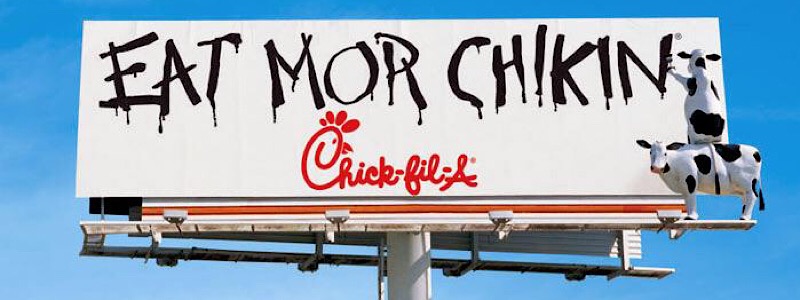
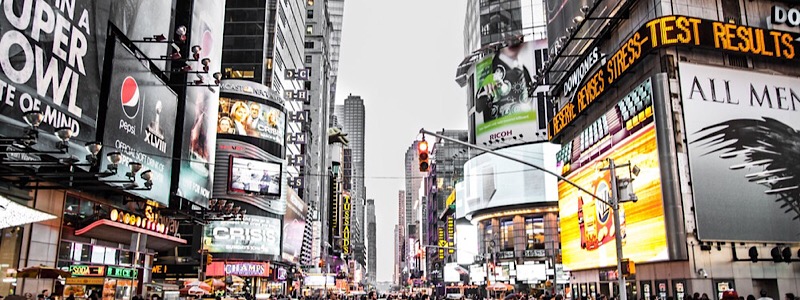
As the industry continues to evolve, more unique effects can be expected in outdoor advertising. 3D elements and visually engaging details have emerged. For example, the famous cows on the Chik-Fil-A signs that “graffiti” billboards to plead consumers to “eat more chikin.” The sides of buildings and skyscrapers are cleverly used for enormous posters and advertisements (such as the now iconic Times Square!) Full vehicle wraps have placed outdoor advertising on the sides of buses, cars, and even planes. 

Smart sensor technologies and facial recognition technologies have created bus stop advertisements that interact with viewers. From games to targeted advertisements with videos and audio, outdoor advertisements have evolved to capture consumer attention in a multitude of different types of digital billboards.

How Outdoor Advertising Has Evolved

Outdoor Advertisement is Still Evolving

It seems that every day, new innovations and methods for advertising outdoors occur. Driven on by market competition, development of new capabilities and polishing of existing processes makes the sky the limit with outdoor advertising.

Billboard Technology

It is a common misconception held by many people that billboards are an “outdated” and “old school” form of advertisement. Oftentimes television ads, websites, or even social media platforms are pushed as the most current and relevant forms of advertising. Despite this, billboards have not gone away and have not become any less useful for spreading a message. Instead, the medium of physical billboards has advanced from new technology becoming available. We’ve gone ahead and compiled a list of billboard technology examples which show some of the options which are possible and how they can be used effectively.

New Billboard Technology

Digital Screens And The Power Of Movement

Screen technology has changed the world. From televisions, to phones, to computers- screens are everywhere. High quality digital screens allow for moving, non-static video to be displayed virtually anywhere, and billboards are no exception.

The ability to have a short video play on a billboard gives advertisers so much more power when it comes to both grabbing an audience’s attention and sending a message.

Video billboards effectively manage to combine all of the strengths of a television ad with the benefits of physical billboards.

bMedia Billboard Technology

Static vs Dynamic Content

What’s more is that digital billboards also make it easy to display and change content. Instead of having to worry about the costs associated with the manual labor of actually putting up a billboard, the content can instead be sent directly to the billboard. Digital billboards are also capable of changing between multiple messages, allowing advertisers to alternate between different ads. This has allowed for digital billboards to completely change their pricing format given that such billboards can now host many more advertisement slots at once.

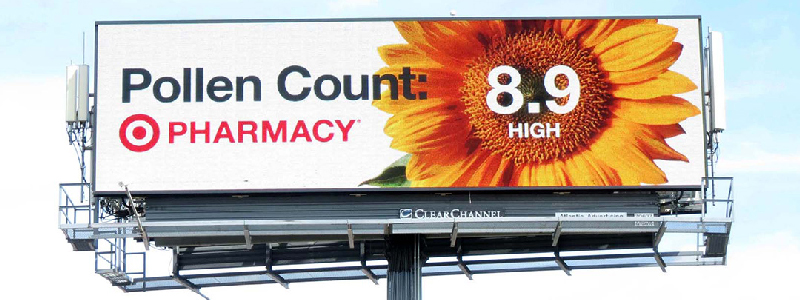
Individual ads are also able to display content which may be time sensitive or reliant upon outside data. While in a traditional billboard the message must be static and hold true at any time during all conditions, the message on a digital billboard can change depending on the time of day, weather conditions, or some other factor.

When messages are able to be tailored around certain fluctuating factors, many opportunities for very convincing marketing strategies open up.

Billboard Technology Target

People Looking At Billboards, Billboards Looking At People

While billboards are things to be looked at, what if a billboard were to do some looking of its own? Technology these days does not stop when it comes to displaying dynamic information, as digital cameras and pattern recognition make it possible for billboards to identify trends within a crowd and change their information accordingly.

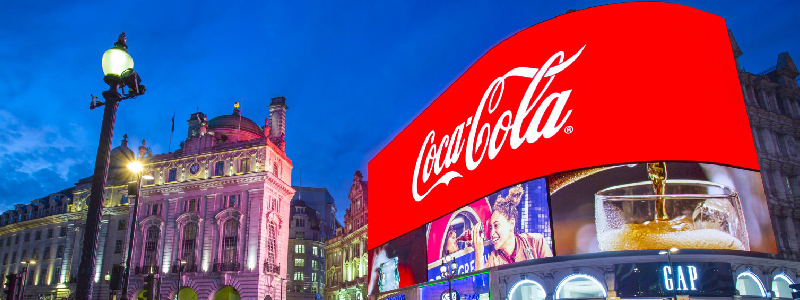
While this type of functionality might sound far fetched, one such example of it includes the Picadilly Lights display in London. On top of having a huge display space, with the ad’s 4K LED screen being the size of two professional basketball courts, the ad is able to detect ages, emotions, and vehicles in order to adjust the content it shows.

As digital ads online have taught us, the best advertisements are targeted. Being able to leverage ad targeting with billboard technology continues to escalate the strength of billboards as an advertising medium.

Digital Billboard Screens

Big Screens For Big Events

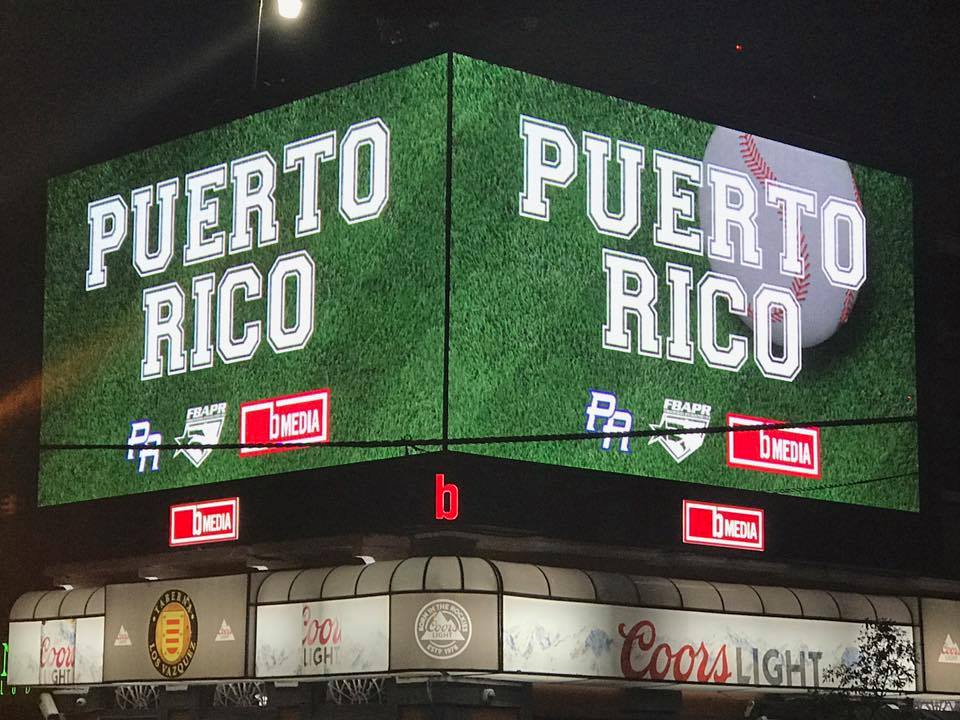
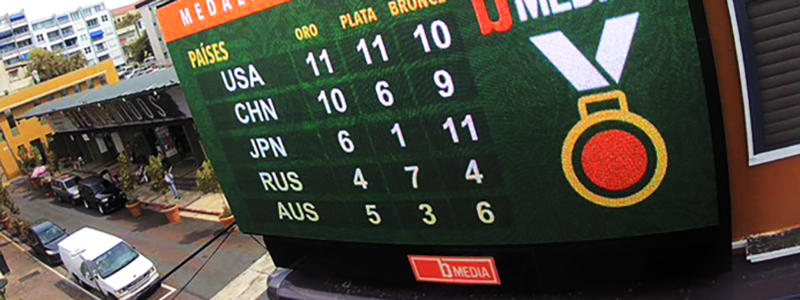
The huge size and quality of new digital screens allow them to be incredibly versatile and multi-purposed. In addition to displaying ads with dynamic content on them, it is also possible to leverage the space in order to display important or popular events, such as a baseball game or concert. Those wanting to draw people to a public space with their event will find their efforts greatly enhanced by making use of such digital billboard technology.

The Mosquito Killer Billboard

Humans have spent all of history protecting themselves from dangerous predators, but one specific animal brings fear into the hearts of people all over the globe. There are ways to fight back against this creature, but no one knows how to stop it completely. Because of a number of factors, it’s becoming a major hazard to the health of the public.

But, in the most unsuspected of places, a solution was found.

A billboard is saving the day in the global battle against mosquitos.

Mosquito Killer Billboard

Basics About the Mosquito Killer Billboard

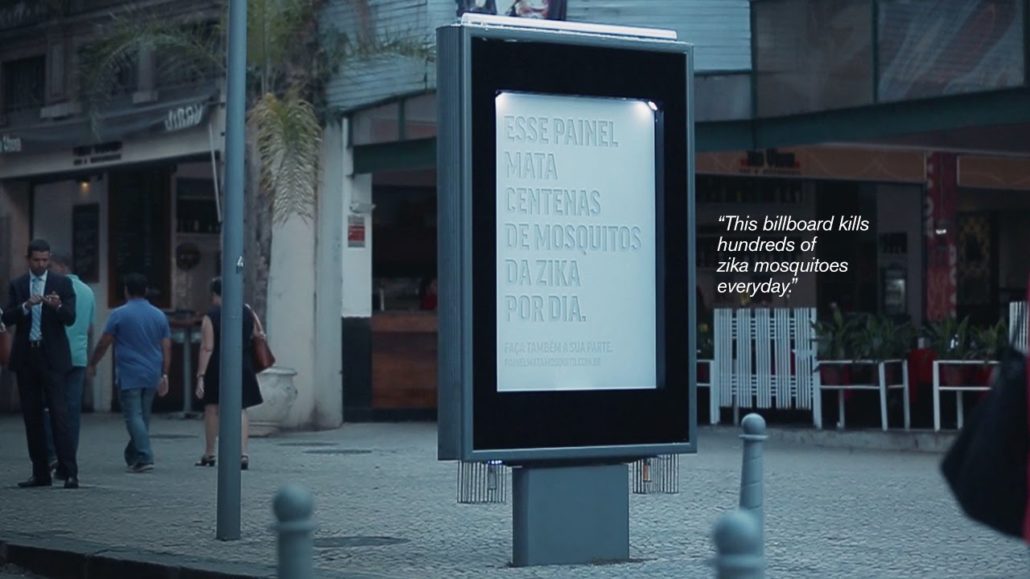
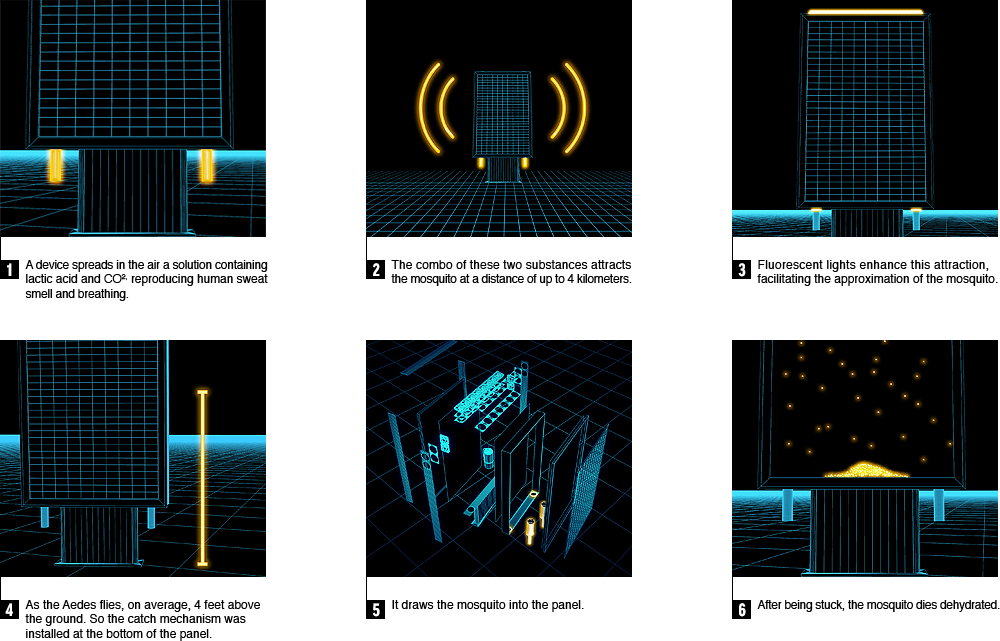
The billboard itself looks normal enough at first sight, but it has a little more than your average sign. It is white with cut out letters, and it contains a message that says “This billboard kills hundreds of Zika mosquitos every day.”

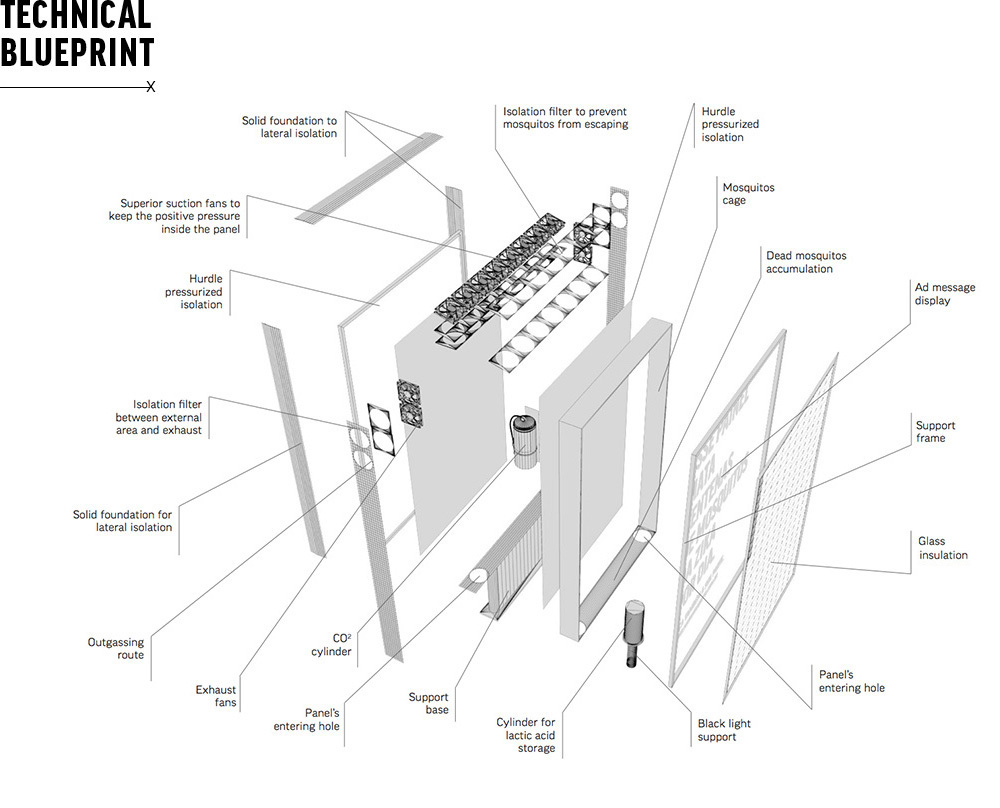
There is some sophisticated machinery built inside of it, and that’s what gives it some teeth. First, it has internal containers that emit carbon dioxide and lactic acid into the air. These are attractive to mosquitos because they’re the same scents that come from humans, so the insects flock to the source. And, it’s so strong that mosquitos will come from distances of up to 4 kilometers (2.48 miles) away.

Once the little animals get closer, they notice the fluorescent lights inside the sign, and that makes them even more interested. Then, they have a little entrance that’s easy for them to find, so they fly right in. Unfortunately for the insects, it’s not so easy to get out. They remain trapped until they die of dehydration.

Why Mosquitos Are a Problem

Mosquitos are a big problem around the world since they act as mini carriers of disease, and they’re extremely hard to stop. This really came to light in 2015 when a major outbreak of the Zika virus began in Brazil, and the world took notice since so many people would be traveling there for the 2016 Summer Olympic Games. Since the virus can cause birth defects in babies born to mothers who have had it, it was significant enough to be called a “Public Health Emergency of International Concern” by the World Health Organization.

Billboard that Kills Mosquitos

The Agencies Behind the Billboard

When creating outdoor advertising, it isn’t normal to make a trap for a dangerous animal. It’s common to try to promote causes related to public health, but they aren’t usually this direct and efficient. However, the creativity that comes out of advertising companies seems to be never ending. This whole project was created by Periscope and NBS, two agencies in Brazil. With the threat of the Zika virus causing so much trouble, they made this solution and taught others how to do the same.

Giving the Design for Free

One very noteworthy part of this billboard is how the agencies who created it gave away the instructions on how to make the mosquito killer billboard. They went so far as to build a website that contains detailed information on how it operates, as well as how to make one yourself.

This was so important because it took it from a publicity stunt and turned it into a gift for humankind. Following a similar strategy can really serve as an inspiration for other organizations to do something similar. And, they can use this as an example if they need to justify investments they’re making in their own projects.

Mosquito Killing Billboard Construction

Not the First Helpful Billboard

A billboard was built in 2013 that helped a major problem in Peru. The area suffers from very low amounts of drinking water because there’s hardly any rainfall. What water the people are able to get is often polluted, but there is often a humidity level over 95%. Seeing a problem and a potential solution, an ad agency partnered with a local university to see what they could do. They ended up creating a billboard that collected water from the air, purified it, and stored it into tanks. Then, people were able to come with bottles and collect the drinking water for their families. It didn’t quite solve the entire issue, but it was a creative solution that helped a lot of people.

Are You Able to Solve a Health Problem?

Even if you don’t think that mosquitos are a major threat, do you have any problems you’ve thought about solving? If so, you don’t necessarily have to do it alone. Sometimes someone has already come up with a solution (like what has happened in this case), and other times you will be able to find help with it. Organizations that are fighting against diseases and other hazards on an everyday basis are usually more than happy to help you turn a dream into a reality.

Let’s try to save the world, one billboard at a time.

McDonalds Pick n Play Billboard Game

From a young age, McDonald’s does a great job of pushing its image of a playful wonderland right into your head. That works pretty well, but eventually you grow up, and Ronald McDonald becomes less and less interesting as the years pass.

But, it’s not only children who like to play. Adults may be too shy to order a Happy Meal, but they enjoy having some games in their life.

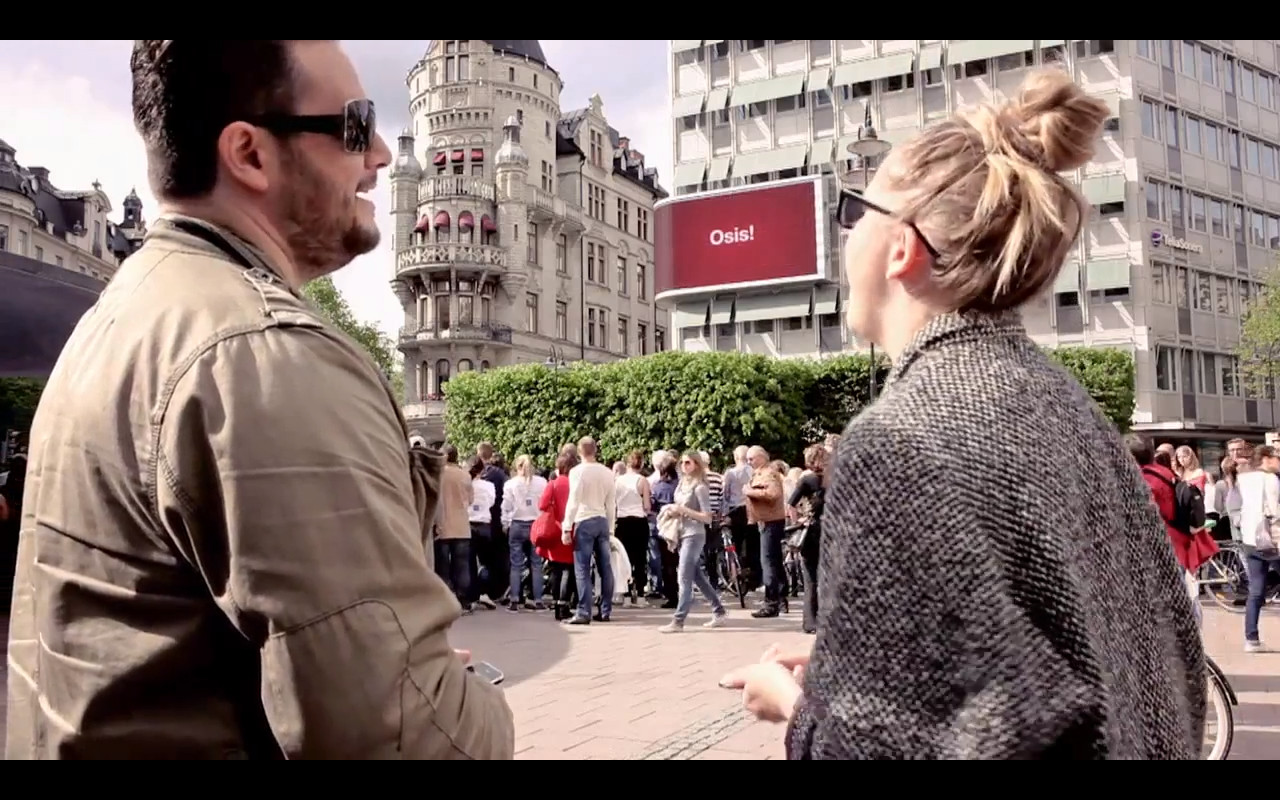
A few years ago, the fast food chain managed to get full grown adults to unleash their inner child. They even managed to make it happen in a crowded square.

But, how did they do it?

McDonalds Pick n Play

A Playground for All Ages

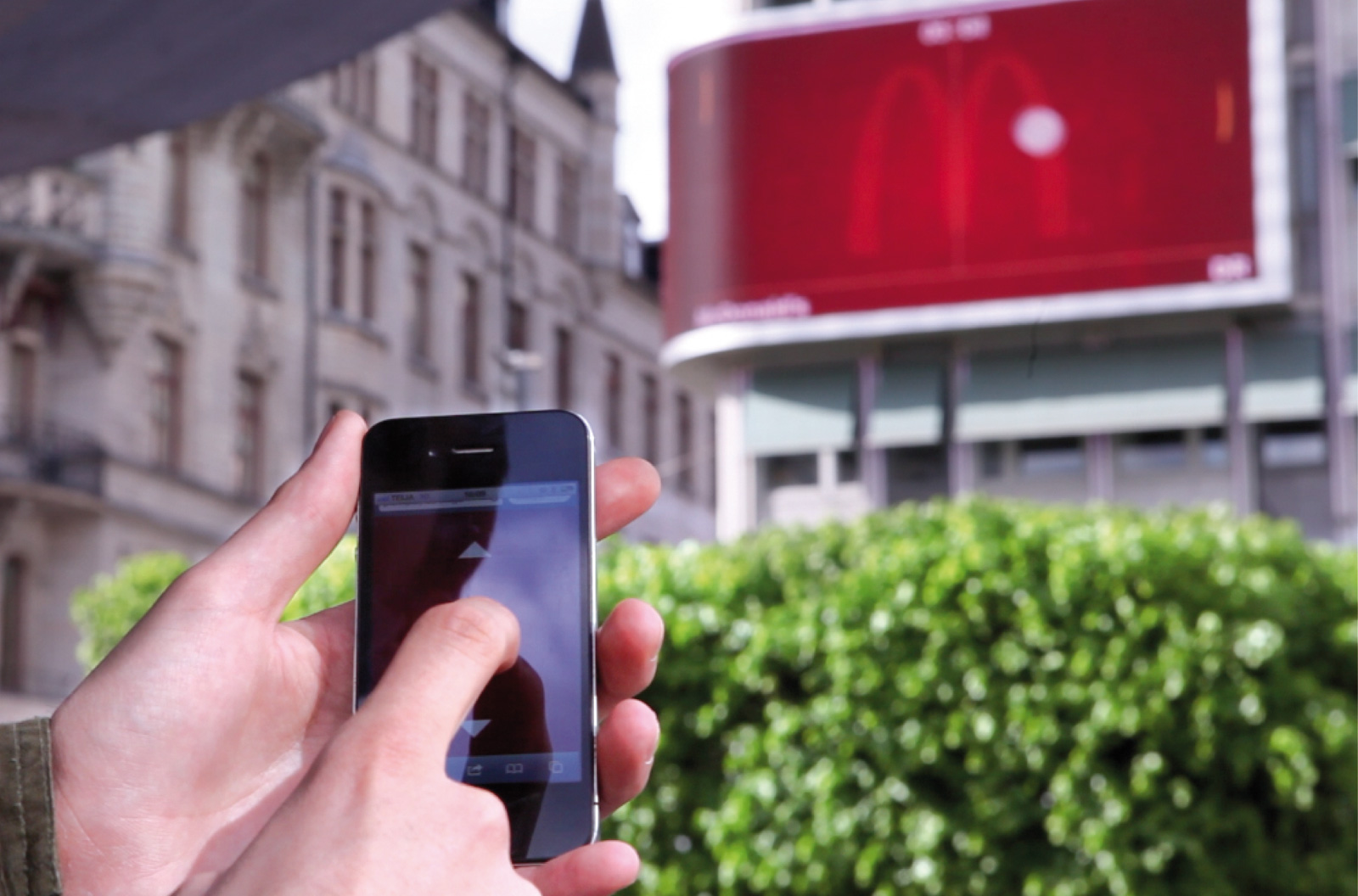
To set the scene, take yourself back to the year 2011, and imagine you’re walking through the streets of Stockholm, Sweden. Now, look up at the giant Golden Arches on a billboard, and pull out your smartphone.

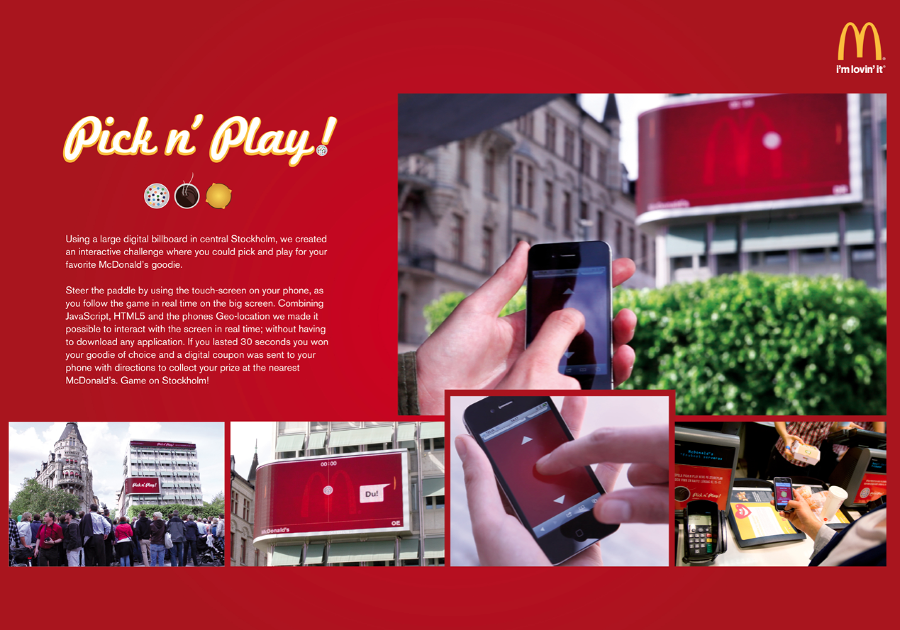
Are you ready for a game? It’s not difficult. As a matter of fact, it’s pretty similar to the game of Pong. The digital display will bring up a video game in which a ball starts bouncing from one side to the other. Using your phone, you move a paddle up and down so the ball doesn’t escape.

Who wouldn’t want to give it a try?

The Details of the Game

This stunt was put together for McDonald’s by DDB Stockholm, and it was quite a hit. Many people participated because it was so easy to do, and if they played well enough, they could win a prize.

The game didn’t require an app download or any other complicated procedure. All people had to do was go to the website that the billboard advertised, and it used their location data to make sure they were actually there.

Consumers got to play, and they had to survive for 30 seconds. If they did, they were rewarded with a coupon for free food at one of the nearby restaurants.

McDonalds Billboard Game

Lack of App Was Key to Success

One of the major reasons this campaign was successful was because of how simple it was. When doing something like this today, many people will instinctively decide to ask consumers to download an app to play along. They even try to build that app in a way that the users can take it with them and play later, and it’s seen as a great reminder of the brand.

While that method can work, it causes a major entry barrier to anyone thinking about participating. That was the real beauty of this one. There weren’t any downloads necessary, and the players didn’t have to register. They just visited the website, played the game, and (hopefully) won.

Then, they popped into a McDonald’s to enjoy their delicious trophy.

Gave Unexpected Interaction to Customers

Another great feature of this campaign was the interactivity it offered. Billboards are often used to advertise a competition or communicate results of something happening, but they’re very rarely the actual game board. Good signs are passively seen and melted into the subconscious of the potential consumers, but it’s proof of a great idea when people want to stop and actively discuss it with each other.

Pick n Play Billboard Game

Free Prizes!

An additional clever aspect of this plan was the call to action that was disguised in the form of a prize. Instead of just suggesting that customers stop by for lunch, they gave them the incentive of free food. They may or may not buy lunch during that visit, but they’ll remember the location (and hopefully the good experience they had) next time they’re in the area.

Also, bragging to friends about winning something for free is always a great way to encourage word-of-mouth communication.

Do You Use Mobile in Your Campaigns?

If you haven’t ever tried integrating mobile experiences in your campaigns, this is a great example of why you should. Don’t forget that it can go far beyond mobile ads or having an app that makes it easier for your customers to interact with your company. Smartphones are a major part of life in the 21st century, so consider them just as strong of a medium as billboards, radio/TV, print, and online channels.

 Not The First McDonald’s Billboard Game

A year before this billboard happened, the same agency created a similar sign for the burger chain. It was less interactive because it only required customers to snap a photo of fast moving foods, and they could show that for a real version of the item for free in a local McDonald’s. As mobile technology improved, the fancier version was possible. Just imagine what we can do now!

Game On!

Have you ever had a similar idea for your business? At bMedia Group, we love to be a part of making these amazing concepts come to life, and we’d be happy to talk about how to turn your creative thoughts into a reality.

Vehicle Recognition Billboards

Do you notice billboards on the side of the road when you’re driving? Most people do, but they’re far more effective if they’re something you can relate to instead of a generic ad. However, this can be quite a challenge for advertisers because of the diverse backgrounds of drivers going past the signs. There’s no way that they can make a billboard that will speak specifically to each driver and blast the right message.

Or, is there?

Yes, there have been a few different times that billboards got a little bit personal with the drivers looking at them!

The Chevy Malibu Is Better Than Your Car

Vehicle Recognition Billboards

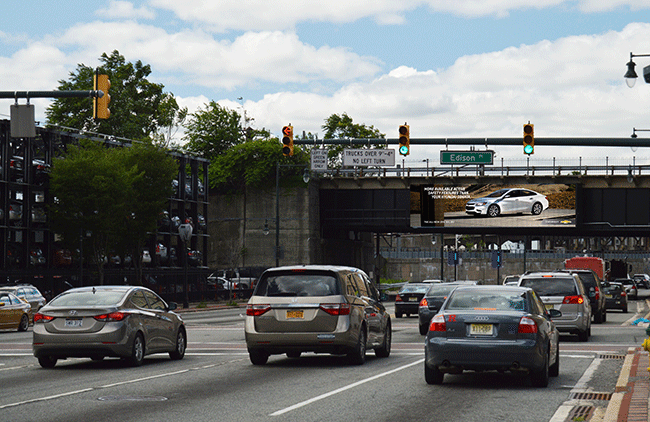
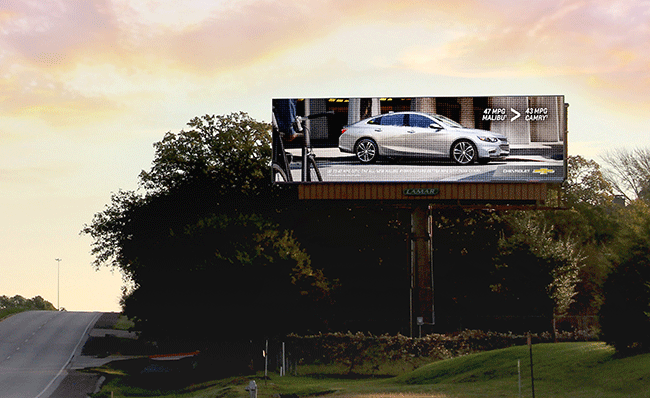
This campaign was one that advertised the Chevy Malibu automobile, but it didn’t simply stop at showing a nice message with an image. Instead, the digital billboard had special technology to register who was watching it, and then it responded in a way that would speak specifically to that audience. So in place of the generic ad, it would directly compare the Chevy to the type of car that the person was driving. For example, it would tell drivers who have a Ford Fusion, Nissan Altima, Toyota Camry, or Hyundai Sonata what better gas mileage (or other benefits) they would have in a Malibu.

Billboards Recognize Vehicles

The campaign was put together as a joint effort between Posterscope USA (an out-of-home communications agency) and Lamar Advertising Company (an outdoor advertising company). It was placed in New Jersey, Dallas, and Chicago, and the timing of the display was key to the whole process. It would change the display with adequate time for the driver to see it as they passed, and then it would change back to the original image.

Also, it’s important to know that the system didn’t save any information about the drivers!

It’s Not Always about Cars

Billboard Vehicle Recognition

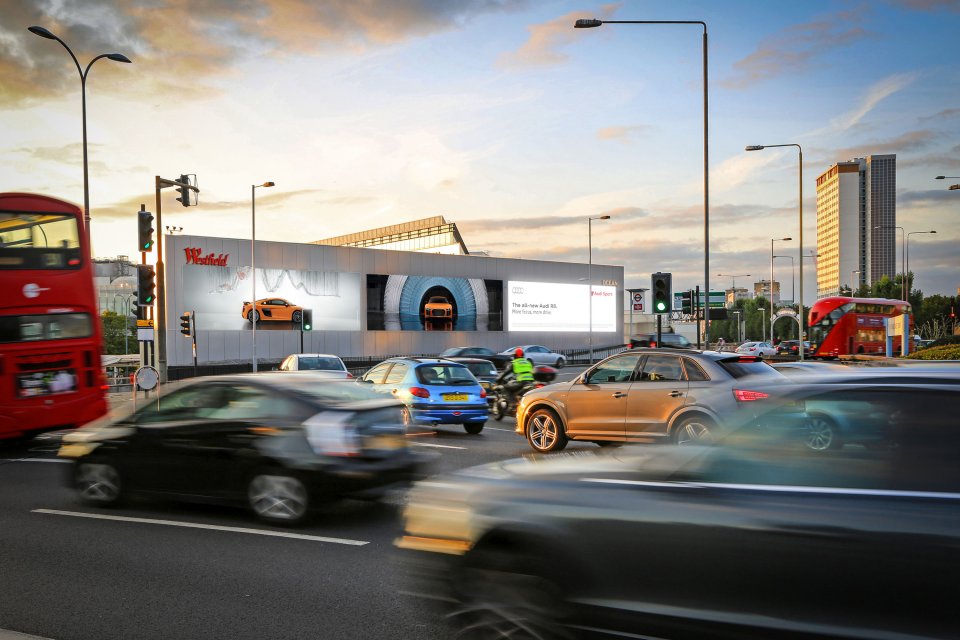
This type of technology can target drivers, but it doesn’t necessarily have to talk about cars. There’s another similar example that was used in London, but it dove more into the interests of the drivers. In this case, there were three digital billboards placed right next to each other, and the whole thing was positioned next to a roundabout. This allowed for more space to deliver a single message, and it was an easier opportunity to mix images with text and logos.

This sign was developed by Ocean, a British advertising agency, and it builds a profile of a driver based on the type of car they’re in. Then it can advertise luxury goods, clothing, newer models of the same car, and other products and services that the particular group might be interested in.

Again, they made a point of saying that it didn’t store any personal information.

These Signs Can Boost Egos

There was an electronic billboard outside of an airport in Melbourne, Australia that liked to help a certain type of customer brag more than usual. Whenever a Porsche was about to cruise by, they would be greeted with the message that “It’s so easy to pick you out in a crowd,” and the Porsche logo. This one was put together by oOH! Media, and it was a great way to make a luxury brand feel even more luxurious.

Education is Necessary to Prevent Fear

One problem with campaigns like these is that people will start to be concerned about their privacy. Because of the fact that the sign is reading them, they’ll be worried that it’s using their image or license plate to store and use data about them. Since having a Big Brother feeling associated with your brand isn’t very desirable, we advise you to educate the public about the workings of any similar projects you do.

However, that can be a great opportunity for a little extra publicity. It’s fairly likely that journalists will be interested in this type of campaign, and they can help spread the message that it isn’t storing data or invading privacy in any way.

Technology is Only Increasing

Billboards like this were technologically impossible just a few years ago, but all of these campaigns managed to do it in different ways. And as the technology improves, it also becomes more affordable. Don’t rule out any sort of advertising ideas as being too expensive until you actually check the prices.

Are Vehicle Recognition Billboards the Future?

These vehicle recognition billboards are pretty incredible, so it’s pretty easy to think that they could be the future of outdoor advertising. That could very well be true, but it’s also very difficult to tell. One of the biggest problems is that a busy road probably doesn’t allow time for every driver to get a customized message, but it still can be really noticeable for the others to see multiple signs in the same place while in their cars.

A Billboard that Identifies People Who Litter

Do you have an opinion on people who litter?  Almost everyone does. Unfortunately, for those living in crowded urban areas, it’s really just a fact of life. Governments and societies try to crack down on it, but many people just don’t listen.

One anti-litter group decided that enough was enough, and they took a fairly radical step to fight the problem.  But, did they cross any ethical lines themselves?  That’s up to you to decide.

The Faces of Litter

The Problem

Hong Kong is a city full of people.  As a matter of fact, the more than 7 million inhabitants crammed into such a small place ranks it as the fourth most densely populated region on the planet.

That many people always adds up to a logistical nightmare when it comes to waste disposal, but it doesn’t help that littering seems to be the official sport.  Every day, there is more than 16,000 tons of waste dumped in the city, and this has given life to the Hong Kong Cleanup Initiative.  The organization’s name is pretty straightforward about what they do, but you might be surprised to learn that they literally launched an in-your-face campaign to combat the problem.

Litter Hong Kong

Basics of the Campaign

The government has already tried many methods of going after this problem, so the campaign had to find a unique way of getting to people.  There are pretty hefty fines given to anyone caught littering, but that just wasn’t motivational enough.  This led the environmental group to team up with Ogilvy & Mather Hong Kong to try and put together something that would really get people listening.  So, the strategy decided on for this campaign was to do a bit of shaming for the litterbugs in society.

They Even Found the Perfect Day to Do It

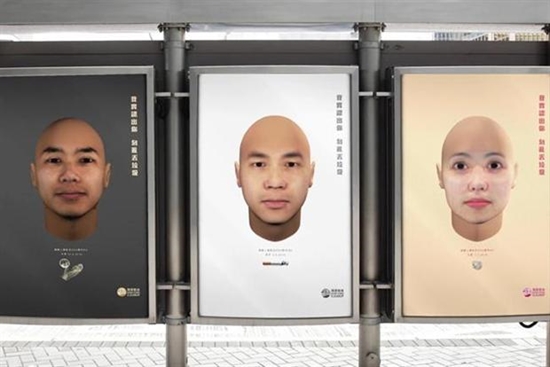
This whole project was called the Face of Litter Campaign, and they had the perfect day to launch it:  Earth Day.  Leading up to it, teams had worked to collect garbage, and they managed to pick up more than 4,000 tons from the streets.  Then, they gave it to some scientists to work their magic.

What Tech Did They Need to Do It?

Scientists at Parabon NanoLabs used Snapshot™ DNA phenotyping to analyze who had touched the various garbage samples, and this allowed them to make a digital drawing of the litterbug responsible for each individual piece.  They tended to focus on bits of garbage that would have physical bits of people left behind, and some of the favorites were coffee cups, cigarette butts, and condoms.  This technology has the ability to predict eye color, hair color, skin color, freckling, shape of the face, and a lot more about people just from a tiny amount of their DNA.  It may sound like something out of science fiction, but that’s the world we live in today.

Do Not Litter Outdoor Media

What Did It Accomplish?

The Hong Kong Cleanup Initiative has some great programs in place to clean up the trash.  Unfortunately, they were really stuck in the pattern of cleaning up after people, and they weren’t having much success in preventing littering in the first place.  That’s where this campaign really helped out – it got people talking.  In only two weeks, it managed to get 3.9 million engagements on social media, and $5 million in earned media coverage.

Advertising vs. Activism

This campaign was very successful by many measurements, but it does raise some ethical questions.  The pictures that were shown were generated drawings of theoretical people, but is it appropriate to publicly shame people?  Even if it works to solve a problem, it can cause harm to people who may or may not deserve it.  We don’t have the answer to this, it’s really up to you and your own personal beliefs.

Science!

A major takeaway from this campaign is how science can be used in advertising.  It’s likely that this whole project would have been far less interesting if they had simply taken photographs of people caught in the act of littering.  It really stands out because of the amazing science that many people didn’t realize was possible, but then it was the perfect chance to convey the message once it had everyone’s attention.

How far will your advertising go?

Have you ever done anything similar to get your message across?  You don’t necessarily have to be so aggressive with your advertising tactics, but this doesn’t change the fact that pulling stunts like this will get you talked about.  So, don’t be afraid to push the limits, but make sure you’re thinking about your image as a whole before you do anything too crazy.

If you’re not sure how to do this on your own, just give us a call.  We’re ready to hear your ideas!